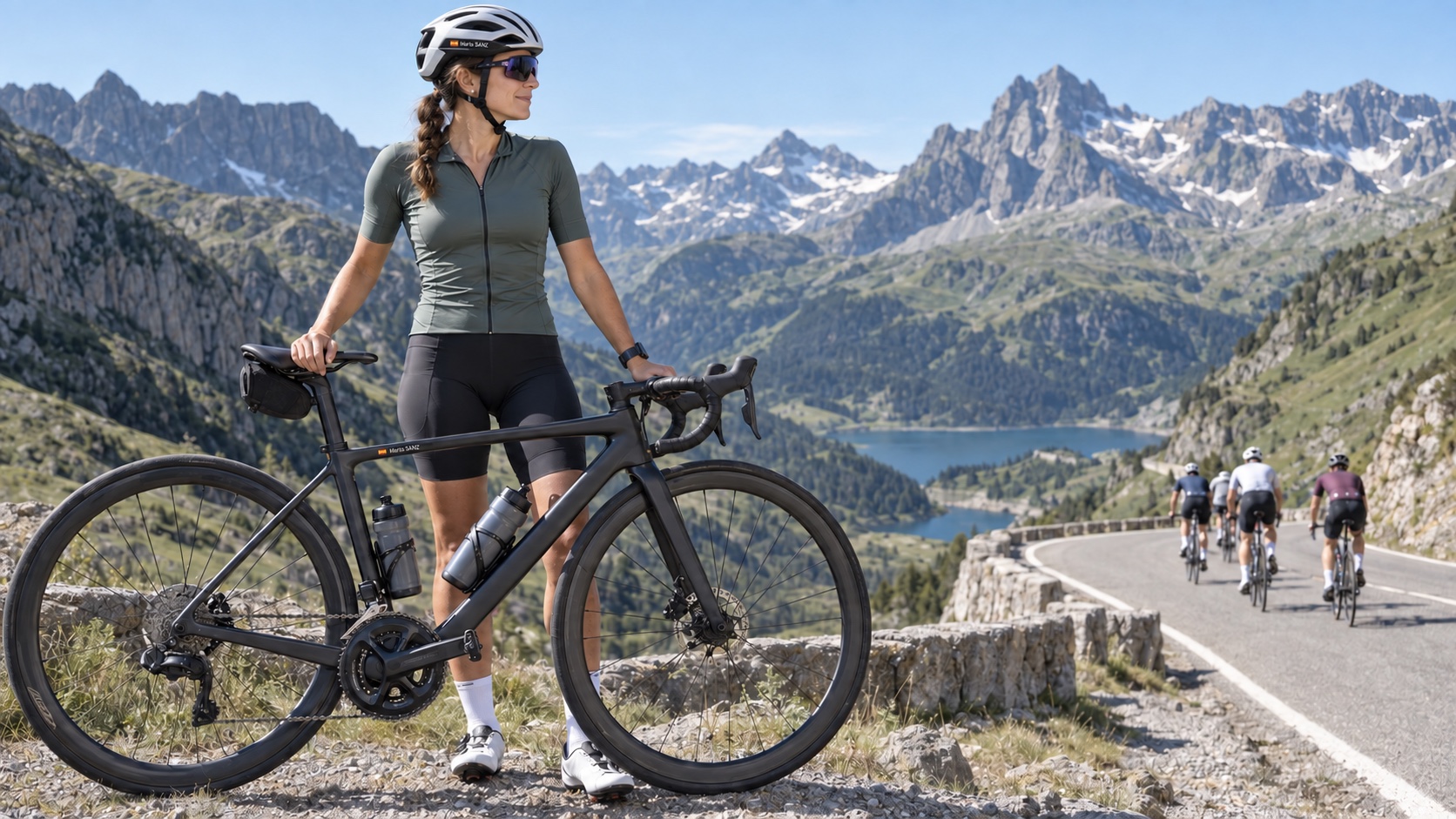
Your name. Your flag. Your next event.
25% OFF · EVENT25
Personalise your bike — save 25%
Use code EVENT25 for 25% off.
The Quebrantahuesos 2027 will bring thousands of cyclists back to the Pyrenees for one of Europe’s most famous and demanding cycling sportives.
Starting from Sabiñánigo in the Spanish Pyrenees, the classic Quebrantahuesos Gran Fondo crosses from Spain into France before returning across some of the most celebrated mountain passes in Pyrenean cycling.
The traditional challenge covers approximately 200 kilometres with 3,500 metres of climbing, including four major passes:
Somport. Marie Blanque. Portalet. Hoz de Jaca.
Checked on 5 October 2026: the official information pages reviewed still describe the 2026 edition; we have not found the final 2027 date or complete entry conditions on those pages. The organiser’s March 2026 announcement about 2027 places described specific promotions linked to 2026 events; it does not establish that those offers remain available.
This guide explains the route, climbs, gearing, training and bike preparation you should consider before taking on Quebrantahuesos.
Your Name. Your Flag. On Your Bike.
CREATE YOUR PERSONALISED BIKE NAME STICKERS →
Quebrantahuesos 2027: What We Know
Based in Sabiñánigo, Huesca, the event offers two different cycling challenges:
Quebrantahuesos Gran Fondo — 200 km
Treparriscos Medio Fondo — 85 km
The published 2026 information describes a lottery and specific licence, insurance and documentation requirements. Check the new 2027 regulations when released rather than assuming that previous conditions, deadlines or accepted documents will remain unchanged.
Do not make non-refundable arrangements on the strength of an estimated date or an old entry promotion. Confirm your place, the event date and the applicable conditions directly with the organiser before committing.
For updates, check the official Quebrantahuesos website.
Quebrantahuesos Route
The classic Quebrantahuesos Gran Fondo covers approximately 200 km and 3,500 metres of accumulated climbing through the Spanish and French Pyrenees. quebrantahuesos.com
Its four defining mountain passes are:
Somport
Marie Blanque
Portalet
Hoz de Jaca
It is an exceptionally demanding combination.
Unlike a shorter mountain sportive where riders can attack individual climbs, Quebrantahuesos requires you to manage your effort across an entire day.
Puerto de Somport
Somport takes riders from Spain towards France.
It comes early enough in the event that many cyclists still feel exceptionally strong — which can become a problem.
The excitement of riding in a huge peloton can make the opening kilometres feel easier than they really are.
Don’t race Somport.
Your objective is to reach the French side having spent as little unnecessary energy as possible.
Col de Marie Blanque
Marie Blanque is where the character of the ride begins to change.
Marie Blanque is famous for its demanding gradients, particularly towards the upper sections.
This is where appropriate gearing starts paying dividends.
Trying to force a large gear may work while fresh, but Quebrantahuesos still has a huge amount of climbing ahead.
Ride within yourself.
Col du Portalet
The Portalet is one of the defining climbs of Quebrantahuesos.
It takes riders back towards Spain on a long mountain ascent where fatigue, heat, nutrition and pacing can all become significant factors.
By this point you will already have accumulated many hours on the bike.
A sustainable rhythm matters much more than your speed during the first few kilometres.
Hoz de Jaca
After the huge mountains, it can be tempting to think the challenge is essentially over.
Then comes Hoz de Jaca.
Its position late in a 200 km Gran Fondo makes it particularly significant.
Shorter climbs can feel very different after thousands of metres of accumulated elevation.
This is exactly why Quebrantahuesos needs to be approached as one complete endurance challenge rather than four separate climbs.
How Difficult Is Quebrantahuesos?
The numbers tell part of the story:
200 kilometres.
Approximately 3,500 metres of climbing.
Four major mountain passes.
Two countries.
But they don’t fully explain the difficulty.
The event attracts an enormous field. In 2026, the event brought 11,500 cyclists from more than 30 countries to Sabiñánigo. quebrantahuesos.com
That means riders also need to be comfortable cycling around large groups, particularly during the faster opening sections.
Distance, climbing and group riding all demand preparation. In addition, Pyrenean weather can change during the ride.
Choosing the Right Gearing for Quebrantahuesos
Don’t choose gearing based on how strong you feel during a one-hour training ride.
Choose it for Marie Blanque or Hoz de Jaca after several hours of riding.
For most amateur cyclists, having an easier climbing gear is far more useful than carrying unnecessarily large gearing.
Your lowest gear should allow you to maintain a sustainable cadence when fatigue becomes significant.
Training for Quebrantahuesos 2027
Preparing for Quebrantahuesos requires more than simply accumulating kilometres.
Build Long-Ride Endurance
Gradually extend your long rides.
You need experience spending many hours on the bike while continuing to eat, drink and maintain a comfortable riding position.
Combine Multiple Climbs
Whenever possible, include several substantial climbs in the same training ride.
Quebrantahuesos isn’t about climbing once while fresh.
It’s about continuing to climb effectively after your legs have already accumulated significant fatigue.
Train Your Pacing
One of the easiest mistakes is starting too hard.
Practise riding long climbs at an effort you know you can maintain repeatedly.
Practise Group Riding
The enormous field means confidence around other cyclists is important.
Ride predictably, communicate and maintain awareness of the cyclists around you.
Bike Setup for Quebrantahuesos
Reliability should take priority over marginal performance gains.
Check Your Brakes
Every major Pyrenean climb is followed by a descent.
Make sure your brake pads, rotors or braking surfaces are in excellent condition.
You should also be comfortable controlling the bike during long mountain descents.
Inspect Your Tyres
Check for cuts, damage and excessive wear.
Use tyres and pressures you’ve already tested rather than experimenting immediately before the event.
Check Your Drivetrain
Inspect the chain, cassette and derailleurs.
Make sure shifting into your easiest gears works perfectly.
If you’re using electronic shifting, charge the batteries.
Test Your Bike After Servicing
If you have the bike serviced before travelling to Sabiñánigo, ride it afterwards.
Never make Quebrantahuesos the first proper test after mechanical work.
Nutrition for a 200 km Gran Fondo
Nutrition becomes critical over 200 mountainous kilometres.
Start eating before you feel hungry.
Use long training rides to determine which foods work for you and how frequently you need to eat.
Don’t rely on hunger as your reminder.
By the time you feel seriously depleted, recovering while continuing to climb can be extremely difficult.
Your aim is to reach Portalet and Hoz de Jaca with energy still available.
Personalising Your Bike for Quebrantahuesos
Quebrantahuesos brings together thousands of passionate cyclists and road bikes from around the world.
It’s exactly the type of event where many riders prepare their equipment down to the smallest details.
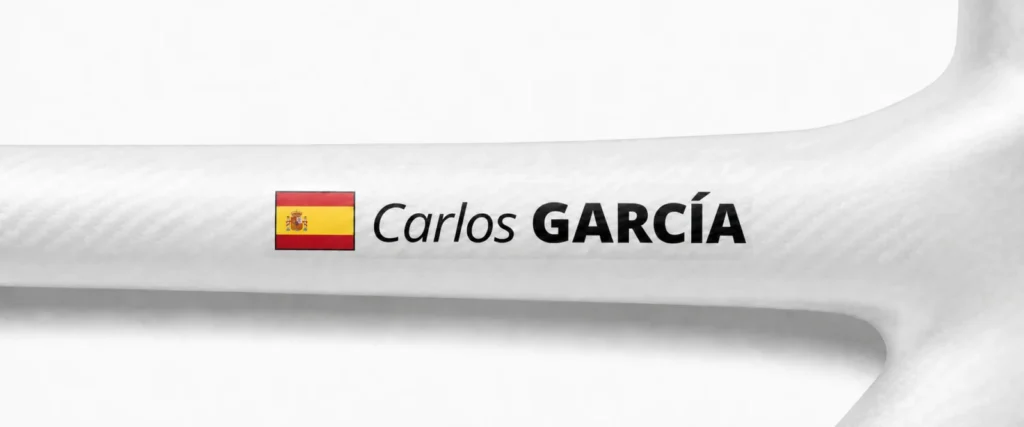
One of those details can be a personalised name-and-flag sticker on the top tube.
It’s a simple way to identify your bike while recreating one of the characteristic personalised details seen on professional race bikes.
Pegatin creates custom cycling stickers featuring your first name, surname and national or regional flag.
Learn more about bike name stickers or discover why professional cyclists put their name and flag on the top tube.
Where to Put Your Name Sticker
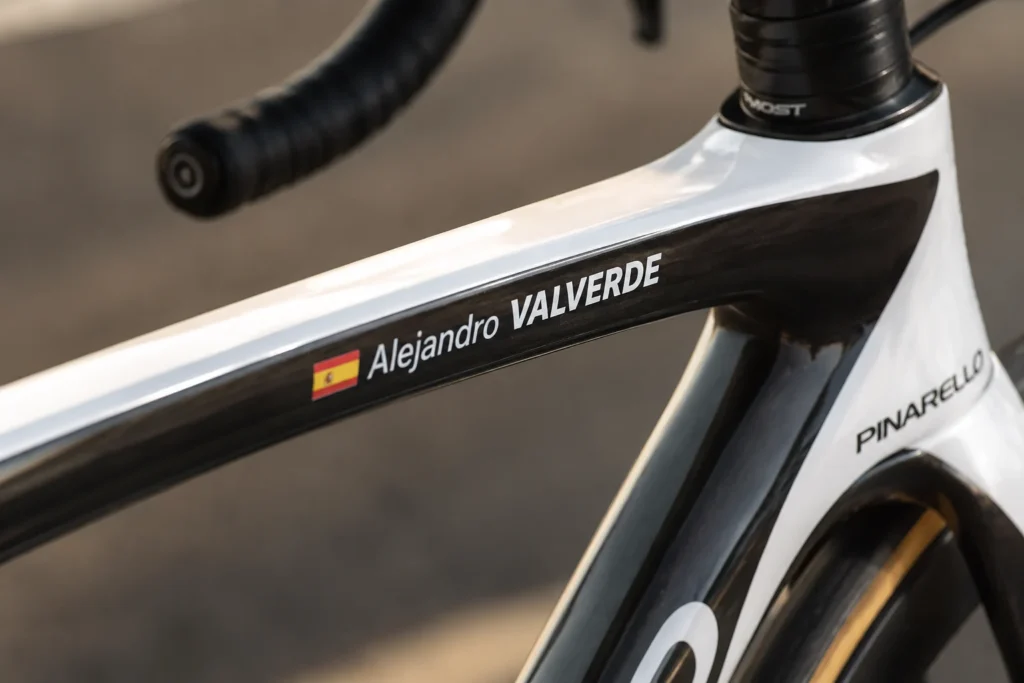
The top tube is the classic location.
It provides a visible but discreet personalised detail and recreates the appearance commonly seen on professional race bikes.
Our guide to bike frame name and flag stickers explains placement in more detail.
A helmet is another possibility, provided its manufacturer permits adhesive decals on that particular model.
See our guide to personalised bike helmet stickers.
Before applying anything, follow our bike sticker application and removal guide.
Make your bike easier to identify and give it a clean professional look.

Quebrantahuesos Preparation Checklist
Before travelling to Sabiñánigo:
- Bike serviced and test ridden afterwards
- Low gearing suitable for steep Pyrenean climbs
- Brakes checked
- Tyres inspected
- Drivetrain running smoothly
- Electronic shifting batteries charged
- Repair kit prepared
- Nutrition strategy tested on long rides
- Hydration plan ready
- Helmet and shoes checked
- Clothing suitable for changing mountain conditions
- Required licence and documentation checked
- Registration arrangements confirmed
- Personalised name-and-flag stickers applied
Quebrantahuesos or Treparriscos?
Not every cyclist needs to start with 200 km.
The 2026 event information lists an 85 km Treparriscos Medio Fondo and a 200 km Quebrantahuesos Gran Fondo. Use these as planning references, not as confirmation of the final 2027 routes.
Choose according to your preparation rather than prestige.
Completing a route strongly and enjoying the experience is more valuable than choosing a distance you’re not ready for.
Final Preparation for Quebrantahuesos 2027
By the final weeks before the event, the important training should already be complete.
Avoid unnecessary changes.
Check your bike, prepare your equipment, confirm your nutrition strategy and arrive in Sabiñánigo rested.
Then you’ll have 200 kilometres of Pyrenean roads ahead of you.
Somport. Marie Blanque. Portalet. Hoz de Jaca.
And one bike carrying your name and your flag across all of them. Order personalised stickers early enough to allow for production and delivery before your departure.
Looking for more major cycling challenges in 2027? Explore our best cycling events in 2027 guide to discover more gran fondos, sportives and iconic endurance rides around the world.
Your name. Your flag. Your next event.
25% OFF · EVENT25
Personalise your bike — save 25%
Use code EVENT25 for 25% off.