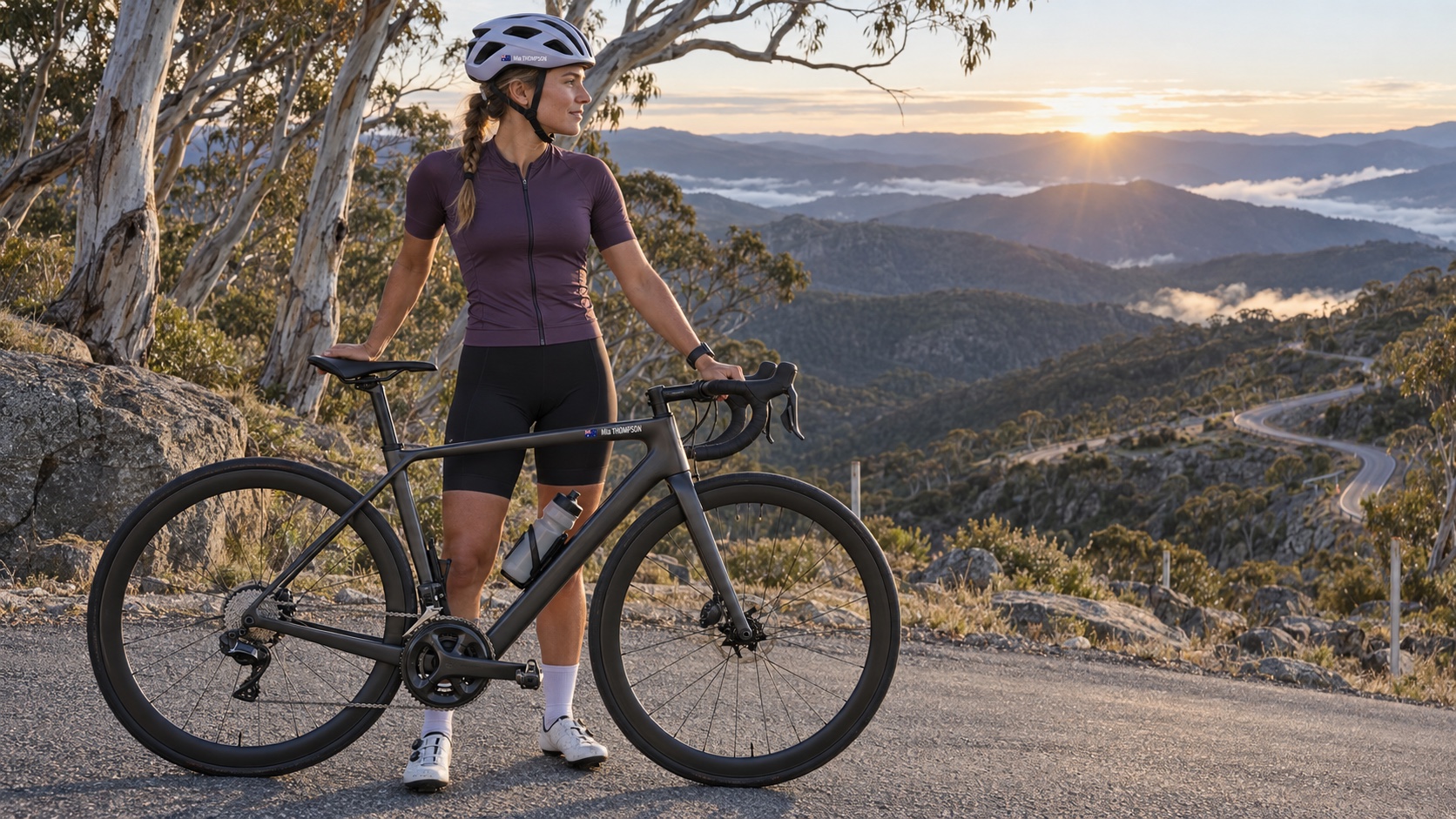
Personalise your bike for your next event — use code EVENT15 for 15% off
Peaks Challenge Falls Creek 2027 will take place on Sunday, March 7, 2027, in the spectacular Victorian Alps.
With 235 kilometres of riding, more than 4,000 metres of climbing and a strict 13-hour time limit, Peaks Challenge is one of Australia’s most demanding one-day cycling events. bicyclenetwork.com.au
Three climbs define the challenge:
Tawonga Gap. Mount Hotham. Back of Falls Creek.
But the real difficulty comes from combining all three into one enormous day in the mountains.
This guide covers the route, climbs, gearing, training, bike setup and equipment you should consider when preparing for Peaks Challenge Falls Creek 2027.
Your name. Your flag. Your Peaks Challenge.
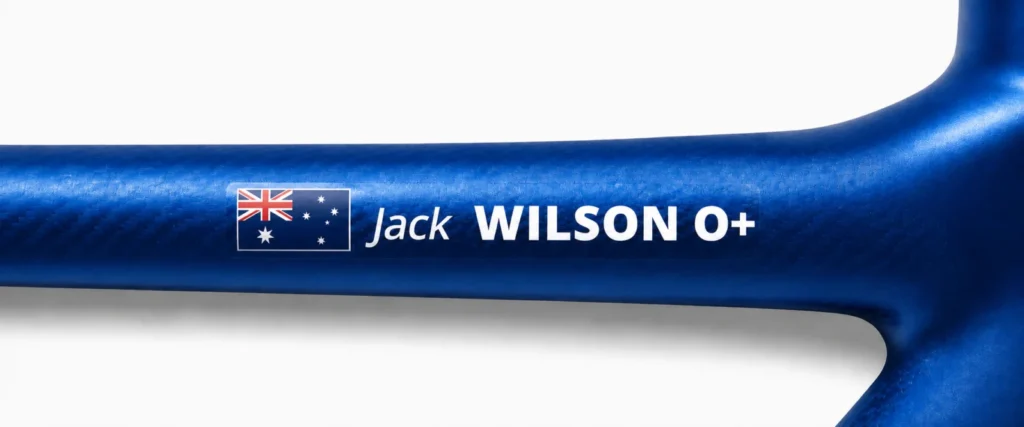
Personalise your road bike with your name and country flag.
Create my Pegatin15% off · Code EVENT15
Peaks Challenge Falls Creek 2027: What We Know
Peaks Challenge Falls Creek 2027 is scheduled for Sunday, March 7, 2027.
The event starts and finishes at Falls Creek in Victoria’s High Country and covers 235 km with more than 4,000 metres of climbing.
Riders have 13 hours to complete the challenge.
The three headline climbs are:
Tawonga Gap — 7.5 km, 476 m elevation gain, approximately 6% average gradient.
Mount Hotham — 29.9 km, 1,303 m elevation gain, approximately 4% average gradient.
Falls Creek — 22.6 km, 980 m elevation gain, approximately 4% average gradient.
The Peaks Challenge Route
The course forms a huge loop through Victoria’s alpine country.
Riders leave Falls Creek before tackling Tawonga Gap, Mount Hotham and eventually the decisive climb back towards Falls Creek.
Comparing the course simply by average gradient can be misleading.
The challenge isn’t one exceptionally steep climb.
It’s accumulating more than 4,000 metres of climbing across 235 kilometres while remaining inside the 13-hour deadline.
Tawonga Gap
Tawonga Gap is the first major climb.
At 7.5 km and around 6% average gradient, it may look relatively manageable compared with what comes later.
That’s precisely why pacing matters.
Your legs will still feel fresh and it’s easy to ride harder than necessary.
Save that energy.
Mount Hotham and Falls Creek are waiting.
Mount Hotham
This ascent changes the scale of the challenge.
The climb extends for almost 30 kilometres and accumulates more than 1,300 metres of elevation gain.
This is where a comfortable climbing position, sensible gearing and disciplined pacing become increasingly important.
Don’t choose your gearing based on how strong you feel during the first hour.
Choose it for the final hours.
Back of Falls Creek
The final major ascent is what makes Peaks Challenge particularly intimidating.
The Falls Creek climb extends for more than 22 km with approximately 980 metres of elevation gain.
But those numbers don’t tell the full story.
You arrive with roughly 200 kilometres already in your legs.
This is where conservative pacing earlier in the ride can make an enormous difference.
The 13-Hour Challenge
Peaks Challenge isn’t only about finishing 235 km.
You must finish within 13 hours.
The organisers operate intermediate cut-off points throughout the course.
That changes the preparation strategy.
You need endurance, but you also need enough sustainable speed to continue progressing throughout the day.
Long training rides should therefore include realistic stops rather than turning every break into an extended café visit.
Training for Peaks Challenge Falls Creek
A 235 km mountain event requires months rather than weeks of preparation.
Your preparation should progressively develop three areas.
Long-Distance Endurance
Build your long rides gradually.
You need to become comfortable spending many consecutive hours on the bike while continuing to eat, drink and maintain a sustainable riding position.
Climbing Under Fatigue
A mountain climb when fresh is very different from a mountain climb after 200 km.
Include training rides containing multiple climbs rather than treating every climbing session as one maximal effort.
Pacing
Practise climbing below your maximum sustainable effort.
The objective isn’t to set your best climbing time on Tawonga Gap.
The objective is to still have usable legs when you reach Back of Falls Creek.
Choosing Your Gearing
For most amateur riders, easier gearing is more valuable here than an unnecessarily large top gear.
Your lowest ratio should allow you to maintain a reasonable cadence on steep gradients even after many hours of riding.
If you’re unsure between two cassette options, think about the gearing you’ll want with 200 km in your legs rather than what feels good during a short training climb.
Preparing Your Bike
Peaks Challenge has an unusually important requirement: your bike must pass an official equipment check before the event.
For the 2027 edition, riders must attend the Event Village on Saturday, March 6. The inspection includes the operation of the front and rear brakes and front and rear lights.
That makes last-minute mechanical experiments particularly undesirable.
Service your bike early enough to complete several proper rides afterwards.
Check Your Brakes
Long alpine descents place considerable demands on braking systems.
Inspect pads, rotors or braking surfaces and make sure everything is functioning correctly before travelling.
Check Your Tyres
Inspect your tyres for cuts, damage and excessive wear.
Use a tyre setup and pressure you already understand.
Peaks Challenge isn’t the place to discover whether a completely new setup works for you.
Check Your Drivetrain
Make sure shifting is precise across the complete cassette, particularly into your easiest climbing gears.
Check chain wear and drivetrain condition.
If you use electronic shifting, fully charge the system and check your batteries before the event.
Mandatory Equipment
The official 2027 entry conditions require riders to carry specific equipment throughout the event.
This includes a helmet, front and rear bike lights, rain or wind jacket, gloves, secondary food supplies, two drink bottles and puncture-repair equipment.
Check the official regulations again close to the event in case requirements change.
Nutrition for Peaks Challenge
A 235 km alpine ride cannot be fuelled reactively.
Start eating early.
Practise your nutrition strategy during training and determine approximately how much carbohydrate and fluid your body tolerates each hour.
The event provides rest areas with nutrition, hydration, medical and mechanical support.
Use them strategically, but don’t make event day the first time you try unfamiliar nutrition products.
Personalising Your Bike for Peaks Challenge
Months of training go into preparing for an event like Peaks Challenge.
For many cyclists, preparing the bike itself becomes part of the experience.
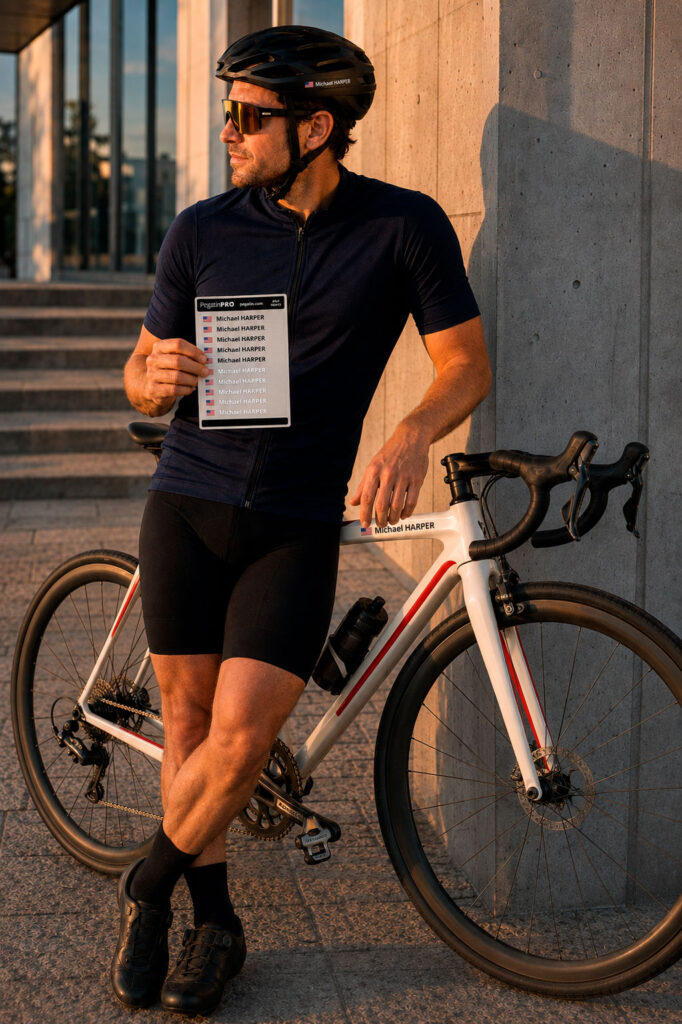
A small personalised name-and-flag sticker on the top tube is one way of giving your bike the same distinctive rider identity seen on professional race bikes.
Pegatin creates personalised cycling stickers featuring your first name, surname and national or regional flag.
Discover our bike name stickers or read why professional cyclists put their name and flag on the top tube.
Where to Put Your Name Sticker
The top tube is the classic position.
Keep the sticker small and discreet so it looks integrated into the bike rather than like a large decorative graphic.
You can see more examples in our bike frame name and flag sticker guide.
A helmet is another possibility, provided its manufacturer permits adhesive decals on the particular model.
See our personalised bike helmet sticker guide.
Before applying your stickers, follow our bike sticker application and removal guide.
Make your bike easier to identify and give it a clean professional look.

Peaks Challenge 2027 Preparation Checklist
Before travelling to Falls Creek, check:
- Bike serviced and subsequently test ridden.
- Brakes inspected.
- Tyres in excellent condition.
- Drivetrain shifting correctly.
- Suitable climbing gearing installed.
- Front and rear lights working.
- Electronic components fully charged.
- Repair equipment prepared.
- Two bottles ready.
- Nutrition strategy tested.
- Rain or wind jacket packed.
- Gloves packed.
- Helmet checked.
- Mandatory bike inspection planned for Saturday.
- Event registration documentation prepared.
- Personalised name-and-flag stickers applied.
Final Preparation for Peaks Challenge Falls Creek 2027
The final weeks aren’t the time to reinvent your preparation.
Your fitness should already have been built.
Use the remaining time to make sure your equipment works, your nutrition strategy is familiar and your bike is ready to pass inspection.
Then comes Sunday, March 7.
235 kilometres.
More than 4,000 metres of climbing.
Tawonga Gap. Mount Hotham. Back of Falls Creek.
And 13 hours to complete the challenge.
Planning more big rides in 2027? Explore our 2027 cycling events calendar to discover more gran fondos, sportives and endurance challenges around the world.
Personalise your bike for your next event — use code EVENT15 for 15% off
Order your Pegatin well before travelling: production and delivery take time. Check current delivery estimates for your destination.