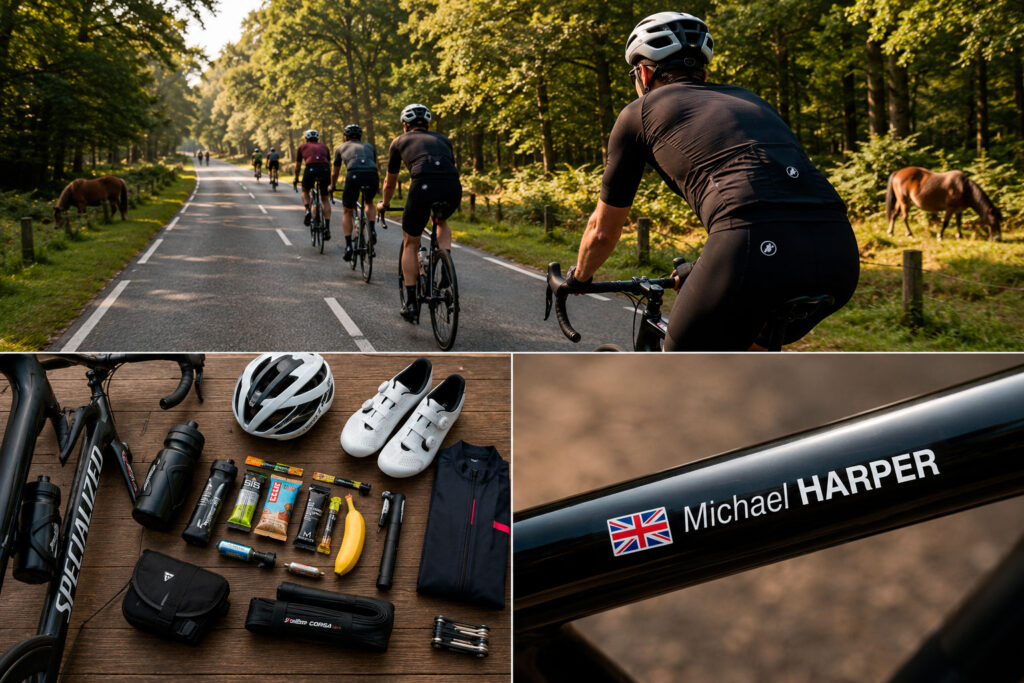
If you’re riding the New Forest Tour 2026, the hard part is already done: you’ve got your entry.
Next, it’s time to make sure you and your bike are ready.
Specifically, the New Forest Tour takes place on Saturday 19 September 2026, starting from Gang Warily Recreation Ground near Southampton and heading into the roads, woodland and open landscapes of the New Forest.
In addition, with four distances available — from a 17 km introductory ride to a 162 km long route — it attracts everyone from newer riders to experienced sportive cyclists.
Therefore, this guide brings together the essential information you need before the event, plus a practical bike and equipment checklist so you can arrive at the start thinking about the ride rather than wondering what you’ve forgotten.
Personalise your bike for your next event — use code EVENT15 for 15% off
→ Create your personalised PegatinPRO pack
Official New Forest Tour 2026 updates
Before travelling, check UK Cycling Events’ official event page for entry availability, route changes and final rider instructions. This independent guide does not replace the organiser’s latest briefing.
New Forest Tour 2026 at a Glance
Date: Saturday 19 September 2026
Start & finish: Gang Warily Recreation Ground, Newland Road, Southampton, SO45 1GA
Routes:
- Long — 162 km / +1,231 m
- Middle — 119 km / +832 m
- Short — 75 km / +496 m
- Rook — 17 km / +79 m
Event difficulty: 2/5 according to the organiser.
Registration opens: 07:30
First riders start: 08:00
Event finish: 17:00
Because the 2026 event is sold out, so if you already have your place, now is the time to focus on preparation.
Make your bike easier to identify and give it a clean professional look.
Which New Forest Tour Route Are You Riding?
Importantly, one of the best things about the New Forest Tour is that it isn’t designed around a single type of cyclist.
There are four routes.
Long Route — 162 km
First, the Long Route is the main endurance challenge.
At 162 km with 1,231 metres of climbing, it is a substantial day on the bike even though the New Forest is not an alpine environment.
Your biggest challenges are likely to be:
- total time in the saddle;
- maintaining sensible pacing;
- eating consistently;
- staying hydrated;
- keeping concentration as fatigue builds.
For many riders, 160+ kilometres is long enough for small mistakes during the first two hours to become big problems later.
However, don’t ride the opening kilometres like a race unless you genuinely intend to race the entire day.
Middle Route — 119 km
Next, the Middle Route covers 119 km and 832 metres of elevation gain.
Even so, it is still a proper endurance ride, but the reduced distance makes it a more manageable target for riders who regularly complete 70–100 km rides.
If you’re stepping up from shorter club rides, pay particular attention to fuelling.
For example, a rider can often complete 60–80 km while getting nutrition wrong.
At 119 km, that mistake becomes much more noticeable.
Short Route — 75 km
Alternatively, the Short Route covers 75 km with 496 metres of climbing.
Consequently, it is an excellent option if this is your first organised sportive or if you want to enjoy the New Forest without turning the day into an endurance test.
Nevertheless, seventy-five kilometres is still long enough to justify proper preparation, though.
Don’t make the mistake of treating the Short Route as something that requires no planning.
Rook Route — 17 km
The 17 km Rook Route has just 79 metres of elevation gain and is aimed at riders looking for a much shorter introduction to the event.
As a result, it offers a way to experience the atmosphere of an organised cycling event without committing to several hours in the saddle.
New Forest Tour 2026 Start Times
The organiser currently lists the following start windows:
Long
08:00–09:00
Middle
08:45–09:30
Short
09:15–09:45
Rook
09:45–10:00
First, registration opens at 07:30.
However, don’t plan to arrive at the exact moment your start window opens.
Give yourself enough time to:
- park;
- register;
- use the toilet;
- prepare bottles;
- check tyre pressures;
- organise your pockets;
- solve any last-minute problem.
In practice, an extra 20 or 30 relaxed minutes before a long ride is far better than starting the day stressed.
What Is the New Forest Tour Like?
Moreover, the routes use the distinctive roads of the New Forest, an area known for woodland, open heathland and free-roaming animals.
Overall, the organiser describes the event as relatively accessible, awarding it 2/5 for difficulty, while still offering a meaningful endurance challenge on the longer routes.
One thing deserves particular attention:
Animals
For example, New Forest ponies and other livestock can be close to or on the roads.
Therefore, this isn’t the place for unnecessary risks on blind corners simply because you’re chasing the wheel in front.
Ride with awareness.
It’s a sportive, not the final kilometre of the Tour de France.
What Do You Get at the New Forest Tour?
According to the organiser, the event includes:
- fully signed routes;
- feed stops;
- chip timing;
- online results;
- event photography;
- medical support;
- mechanical support;
- food and drink;
- free parking;
- finisher medal.
As a result, that makes navigation and support considerably easier, but you should still treat yourself as a self-sufficient cyclist.
However, mechanical support doesn’t mean you should start without a spare tube.
What Should You Bring to the New Forest Tour?
Accordingly, here’s the checklist we’d use.
On the rider
- cycling helmet;
- jersey;
- bib shorts;
- cycling shoes;
- socks;
- gloves if preferred;
- sunglasses;
- lightweight rain layer or gilet depending on conditions;
- mobile phone;
- payment card or emergency cash;
- identification.
Your helmet is also an ideal place for personal identification. If you’ve never considered it, read our guide to putting your name and flag on your cycling helmet.
On the bike
- two bottles if your setup allows it;
- spare inner tube or tubeless repair system;
- tyre levers;
- mini pump or CO₂ inflator;
- multitool;
- chain quick-link compatible with your drivetrain;
- small saddle bag or storage solution.
Nutrition
First, bring nutrition you already know works for you.
However, race day is not the best time to discover that your stomach hates a new energy product.
Depending on your route and pace, this could include:
- energy bars;
- gels;
- bananas;
- carbohydrate drink;
- small sandwiches or other familiar solid food.
Although the event has feed stops, but carrying some of your own nutrition gives you more control.
How Should You Prepare Your Bike?
Above all, do not leave basic bike maintenance until Friday night.
Therefore, several days before the event, check:
Tyres
Look for:
- cuts;
- excessive wear;
- embedded debris;
- pressure;
- sealant level if you’re tubeless.
Brakes
In addition, make sure braking is consistent and that your brake pads have sufficient material remaining.
Drivetrain
Likewise, your chain should be clean, lubricated and running quietly through every gear.
Bolts and components
Finally, check obvious contact points and accessories, particularly:
- bottle cages;
- computer mount;
- saddle;
- seatpost;
- thru-axles or quick releases.
If something doesn’t feel right, fix it early enough to test the bike before the sportive.
Consequently, the ideal pre-event preparation ends with a short test ride — not with you discovering a new problem at 22:30 the night before.
Don’t Fit Major New Components the Night Before
Of course, a sportive can be a great excuse to upgrade your bike.
However, don’t install a radically different saddle, new cleat position or untested equipment immediately before a 162 km ride.
Every contact point matters:
- hands;
- feet;
- saddle.
For example, something that feels fine for twenty minutes can become extremely uncomfortable after four hours.
Test changes first.
What Tyre Pressure Should You Use?
Importantly, there isn’t one correct tyre pressure for every New Forest Tour rider.
Instead, it depends on factors including:
- rider weight;
- tyre width;
- internal rim width;
- tyre construction;
- tubed or tubeless setup;
- road conditions.
Therefore, use a reliable tyre-pressure calculator appropriate to your equipment rather than automatically pumping road tyres to the highest number printed on the sidewall.
Ultimately, comfort and grip matter on a long sportive.
How Much Should You Eat During the Ride?
Similarly, nutrition requirements vary between riders, intensity and duration.
However, the important rule is simpler:
don’t wait until you’re hungry to start eating.
For longer routes, therefore,, establish a routine early in the ride.
In practice, small, regular amounts are usually easier to manage than suddenly trying to compensate after several hours without enough fuel.
Likewise, the same applies to drinking.
Therefore, take regular drinks instead of waiting until you feel badly dehydrated.
How Hard Should You Ride the First Hour?
Easier than your ego wants you to.
At first, sportive start areas create excitement.
For example, there are riders everywhere. Groups form quickly. Someone always comes past slightly faster than you.
As a result, it is very easy to spend the first hour riding at somebody else’s pace.
If you’re doing 119 or 162 km, ask yourself:
Could I comfortably maintain this effort several hours from now?
However, if the answer is no, let the group go.
After all, there will be another one.
Riding in Groups
Moreover, one of the pleasures of a sportive is riding with other cyclists.
In addition, it can make the ride faster and more efficient.
But if you’re not accustomed to group riding:
- avoid overlapping wheels;
- hold a predictable line;
- don’t brake suddenly without reason;
- communicate hazards;
- don’t stare only at the wheel immediately in front;
- leave additional space if conditions are wet.
Smooth is fast.
Predictable is safe.
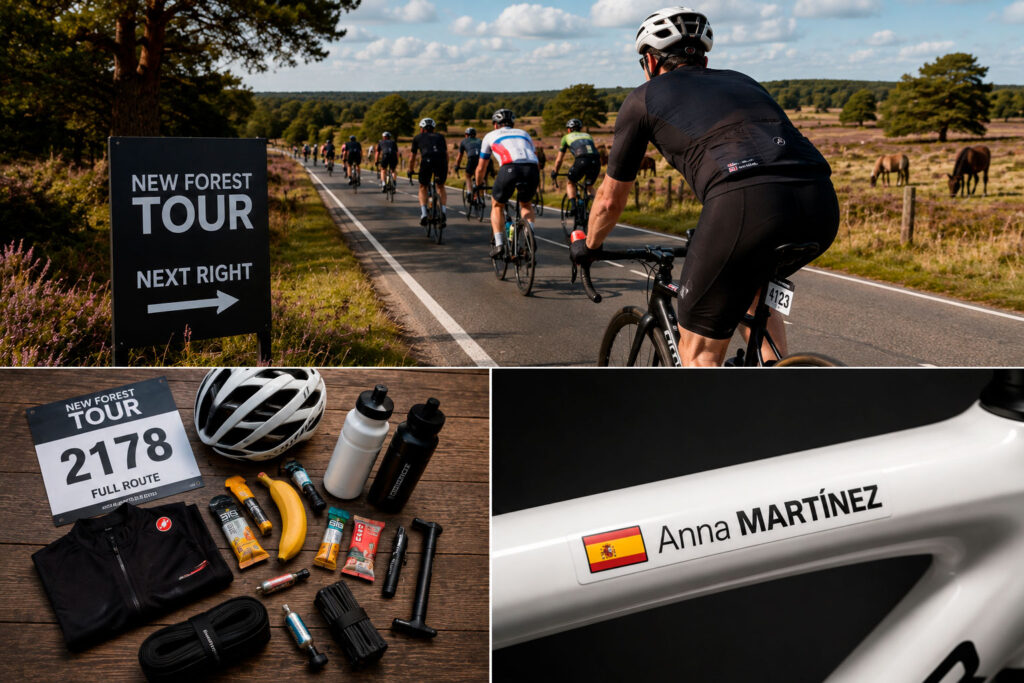
→ Create your personalised PegatinPRO pack
Make Your Bike Easy to Recognise
At an organised event, for example,, you’re surrounded by road bikes.
In fact, sometimes extremely similar road bikes.
Canyon in black.
Specialized in black.
Trek in black.
Cervélo in black.
And another one.
Fortunately, one very small detail can make your bike immediately personal:
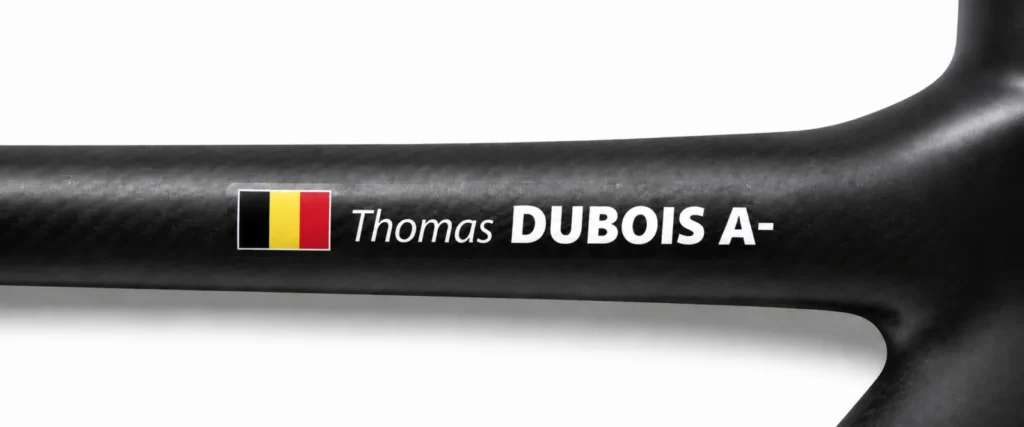
your name and national flag on the top tube.
Importantly, it isn’t just an aesthetic idea. Professional cycling teams use rider identification because mechanics often manage multiple nearly identical bikes. If you’re interested in the story behind it, read why professional cyclists put their name and flag on the top tube.
For amateur cyclists, however,, the idea is even simpler:
it makes the bike unmistakably yours.
For example, a subtle personalised name-and-flag sticker adds identity without changing the visual design of the frame.
Furthermore, it can also make your bike much easier to identify among hundreds of machines at a sportive, gran fondo, club event or triathlon transition.
Not Sure Which Pegatin Pack You Need?
Ultimately, the colour and finish of your bike matter.
Pegatin offers BASIC, PRO and PLUS, and each option is designed for slightly different uses and surfaces.
Before ordering, see our full comparison of Pegatin BASIC vs PRO vs PLUS and which pack is best for your bike.
For most cyclists who want flexibility across dark and light surfaces, the PRO pack is particularly useful because it includes both black and white versions.
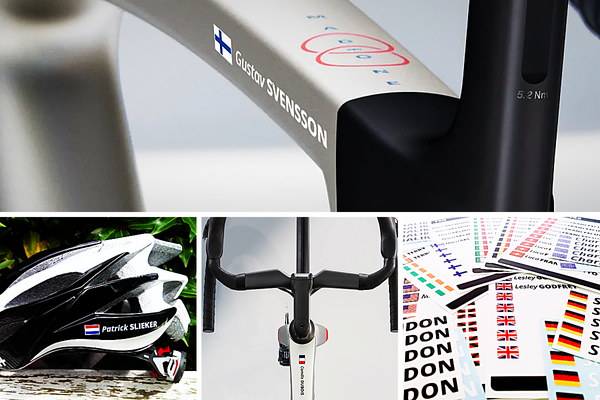
What Should You Put on Your Sticker?
The classic combination is simple:
flag + first name + surname.
But you can also use nicknames, club references or other short combinations.
If you’re undecided, we’ve put together a separate guide explaining what to put on your personalised bike sticker beyond just your name.
Where Should You Put Your Name Sticker?
The classic position is the top tube, where rider names are commonly seen on professional race bikes.
Other useful positions include:
- helmet;
- seatpost;
- fork;
- cycling computer;
- other smooth cycling equipment.
Before applying anything:
- clean the surface;
- remove grease and residue;
- allow it to dry completely;
- position the sticker before committing;
- apply it carefully.
If your frame is carbon and you’re concerned about adhesives, don’t guess. Read our detailed guide: Do Stickers Damage Your Carbon Frame?.
Make Your Helmet Yours Too
Your bike doesn’t have to be the only piece of equipment carrying your identity.
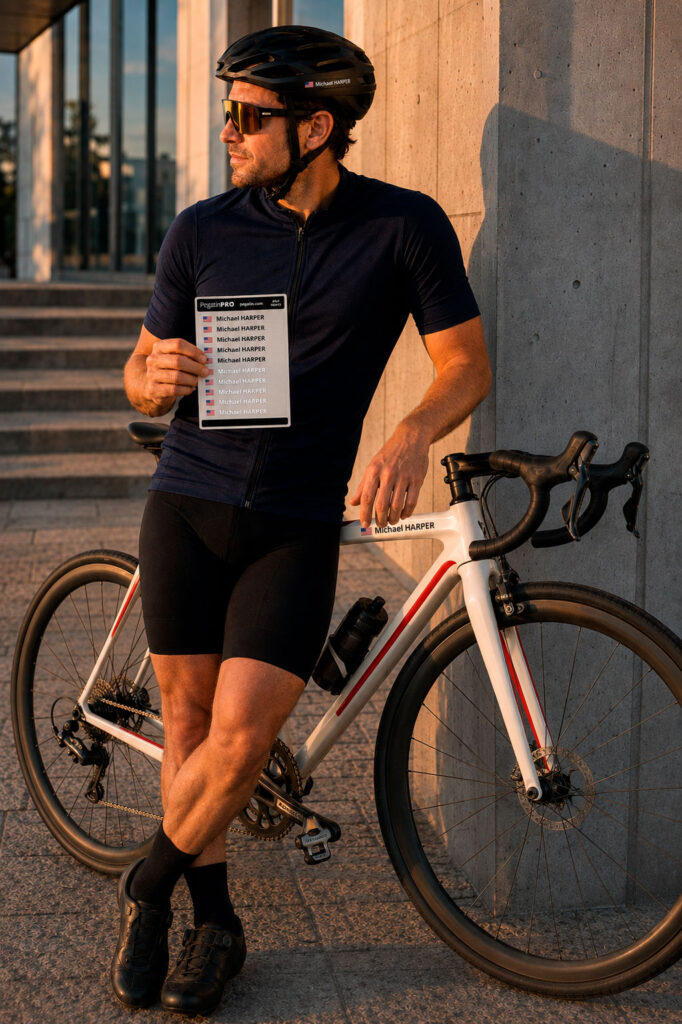
A small name-and-flag sticker on your helmet creates the same visual identity across your setup.
This is particularly useful during:
- sportives;
- gran fondos;
- races;
- club events;
- training camps;
- triathlons.
It can also make you easier to recognise in event photographs and within a large group.
For placement and finish recommendations, see our complete guide to personalised name-and-flag stickers for cycling helmets.
Riding the New Forest Tour With Your Cycling Club?
If several members of your club are riding together, matching personalised stickers can create a professional and consistent team identity while still displaying each rider’s individual name.
We’ve explained the options in our guide to matching name stickers for cycling clubs and teams.
The Night Before
Your preparation should already be finished.
Lay everything out.
Bike ready
✓ tyres checked
✓ drivetrain checked
✓ bottles ready
✓ computer charged
✓ lights charged if required
✓ repair kit installed
Kit ready
✓ helmet
✓ shoes
✓ jersey
✓ bib shorts
✓ socks
✓ glasses
✓ weather layer
Pockets ready
✓ phone
✓ food
✓ wallet/card
✓ keys
✓ identification
Logistics ready
✓ route to venue
✓ parking plan
✓ registration details
✓ alarm
✓ breakfast
The goal is to wake up and execute the plan.
Not start making decisions.
Breakfast on Event Morning
Eat a breakfast you’re familiar with.
A cycling event is not the time for experimental nutrition.
Give yourself enough time to eat, digest and travel without rushing.
And remember that breakfast is only the beginning.
If you’re riding the Long Route, you will still need to fuel during the event.
Check the Weather — But Do It Late
September weather in southern England can vary considerably.
Do not make final clothing decisions a week in advance.
Check the forecast close to the event and choose your kit accordingly.
Useful options can include:
- packable gilet;
- rain jacket;
- arm warmers;
- lightweight gloves.
The goal isn’t to carry your entire wardrobe.
It’s to have a sensible solution if conditions change.
After the Finish
Don’t immediately jump into the car after a long day.
Drink.
Eat.
Change out of wet kit if necessary.
Give yourself a few minutes.
And take the photo.
You’ve just finished the New Forest Tour.
Your bike deserves to be in it too.
New Forest Tour 2026 FAQ
When is the New Forest Tour 2026?
The event takes place on Saturday 19 September 2026.
Where does the New Forest Tour start?
All routes start from Gang Warily Recreation Ground, Newland Road, Southampton, SO45 1GA.
How long is the New Forest Tour?
There are four routes:
- Long: 162 km
- Middle: 119 km
- Short: 75 km
- Rook: 17 km
How much climbing is there?
The organiser lists:
- Long: +1,231 m
- Middle: +832 m
- Short: +496 m
- Rook: +79 m
Is the New Forest Tour difficult?
The organiser rates the event 2/5 for difficulty, although the 162 km route still requires significant endurance simply because of its distance.
Is the New Forest Tour 2026 sold out?
Yes. The organiser currently lists the 2026 event as sold out.
Are there feed stops?
Yes. Feed stops are included among the event services listed by the organiser.
Is the route signposted?
Yes. The organiser lists fully signed routes among the event features.
What time does the Long Route start?
Long-route riders currently have a start window of 08:00–09:00.
Should I personalise my bike for a sportive?
You don’t need to, but a small name-and-flag sticker is a simple way of making your bike immediately identifiable and giving it the rider-identification detail commonly seen on professional race bikes.
If you’re unsure which version will suit your bike, compare Pegatin BASIC, PRO and PLUS before ordering.
One Final Tip
The best sportive preparation is not about buying the most equipment.
It’s about removing unnecessary problems before they happen.
Prepare your bike.
Prepare your kit.
Know your route.
Eat before you need to.
Ride your own pace.
And make the bike you’re going to spend all those hours riding feel like your bike.
Looking for more organised rides to add to your calendar? Explore our 2027 cycling events calendar to discover more sportives, gran fondos and endurance cycling events around the world.
Create your personalised Pegatin and give your bike the PRO look
See you on the road.
Personalise your bike for your next event — use code EVENT15 for 15% off