Helmet sticker size guide: choose between 5 mm letters in BASIC or PRO and 7 mm letters in PLUS. Start by checking that your helmet manufacturer permits adhesive decals, then measure the usable panel.
Your name. Your flag. Your size.
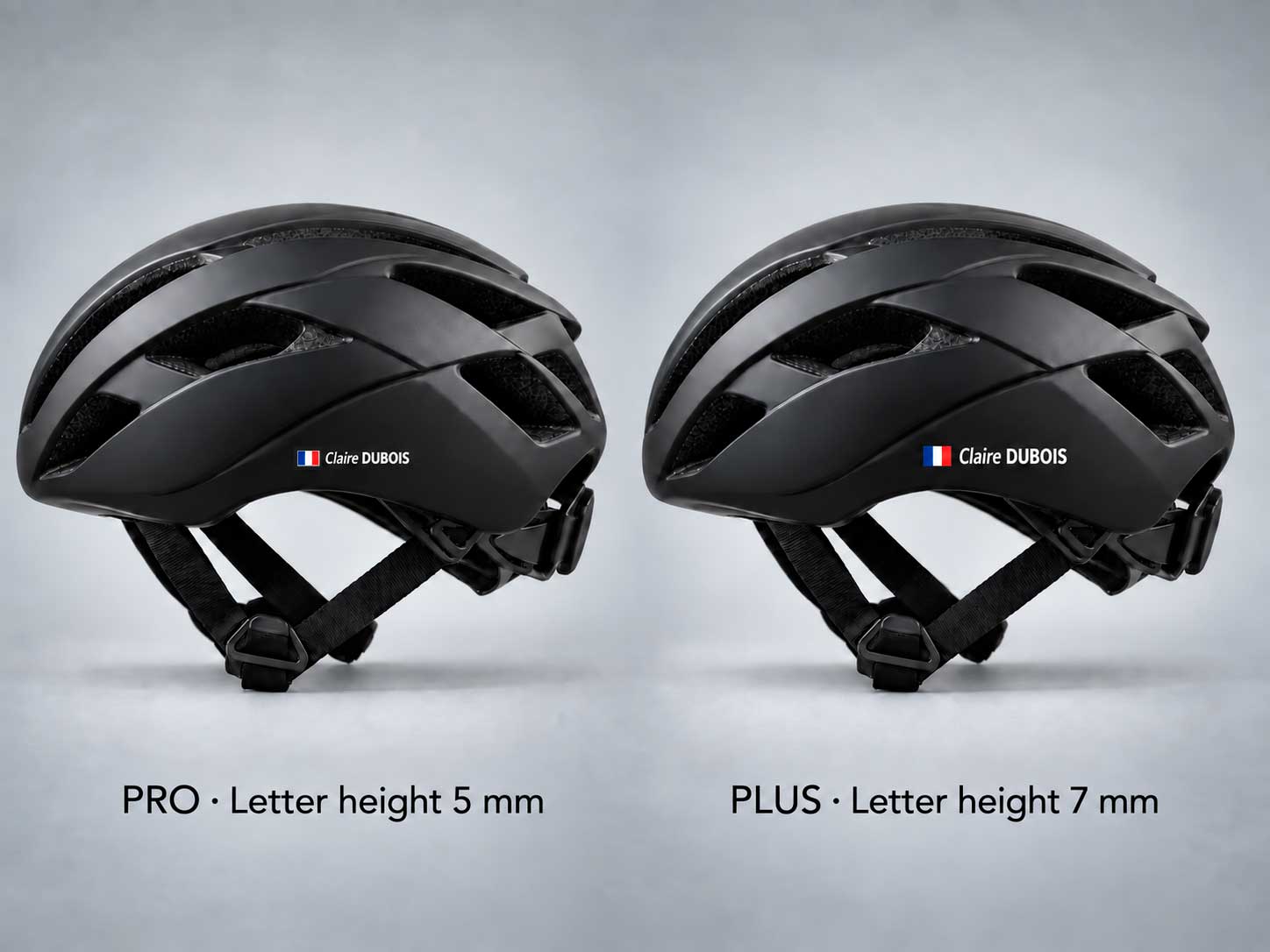
Compare the real letter height: BASIC and PRO use 5 mm letters; PLUS uses 7 mm letters.
Choose your Pegatin pack and personalise it with your name and flag.
Create my PegatinSave 15% with HELMET15
Free worldwide shipping.
A personalised helmet sticker should be easy to read without taking over the helmet. If it is too small, your name and flag disappear from a few metres away. If it is too large, it can look out of proportion and may sit too close to vents, edges or safety labels.
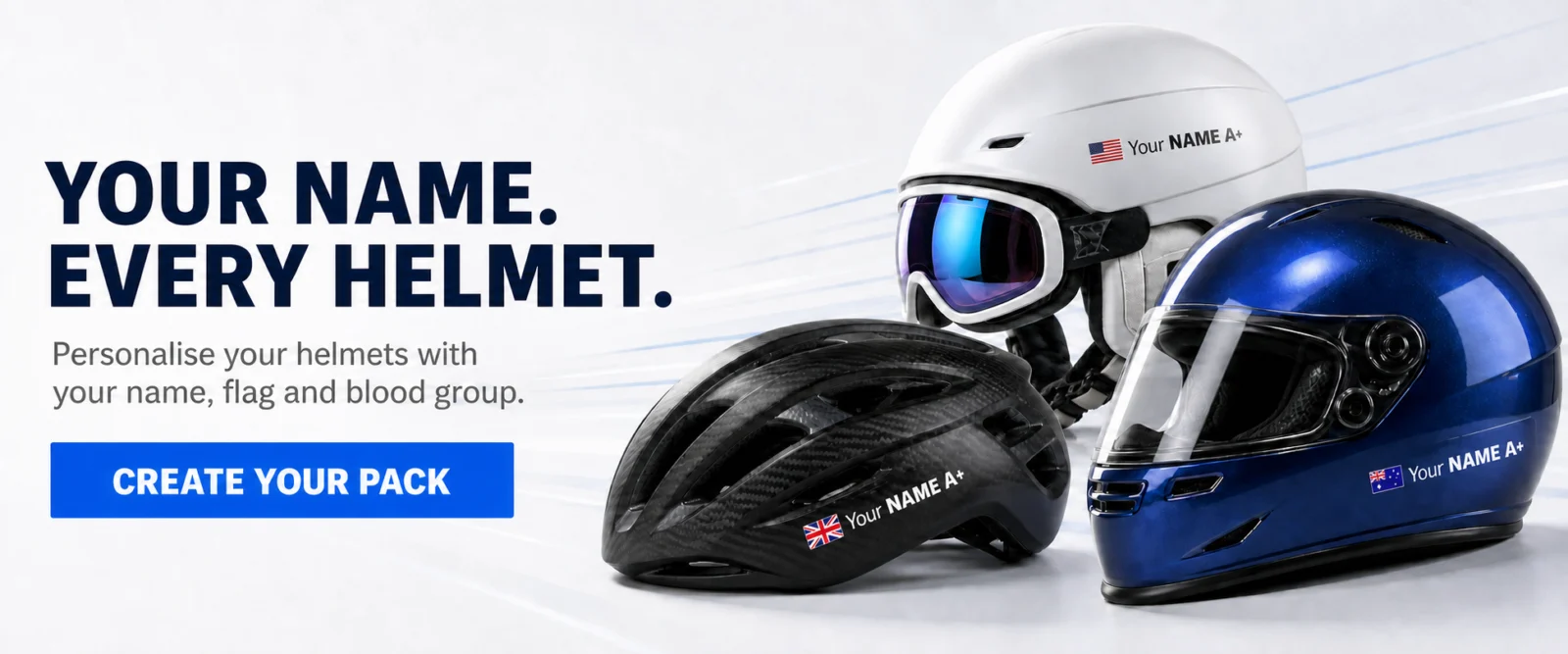
This helmet sticker size guide explains how to choose between the two real Pegatin letter heights for cycling, motorcycle, karting, ski, equestrian and junior helmets. BASIC and PRO use 5 mm-high letters; PLUS uses 7 mm-high letters. Measure the usable surface first, then choose the pack whose fixed lettering height fits it best.
Quick rule: aim for a decal that fills roughly half to two-thirds of the clean, usable width of the chosen panel. Leave clear space around vents, shell edges, visor hardware, straps, adjustment systems and certification labels.
Helmet sticker size guide: measure before ordering
- Choose the intended position. The side or rear of the helmet usually offers the cleanest view, but the best position depends on the sport and shell design.
- Find the usable area. Measure only the smooth section that is free from vents, ridges, sharp curves, mechanisms and permanent labels.
- Measure the width in a straight line. Use flexible measuring tape or a narrow strip of paper. Do not wrap the decal around a strong compound curve.
- Keep breathing room. A visible border of helmet colour makes the result look deliberate and professional.
- Test with paper. Cut a paper rectangle to the proposed size, hold it in place and view the helmet from two or three metres away.
Choose BASIC or PRO when 5 mm lettering gives the most discreet, proportionate result. Choose PLUS when the available smooth panel can comfortably accommodate its 7 mm lettering and greater visibility is useful. These are the only two Pegatin letter heights.
For a side-by-side overview of the available options, see Pegatin BASIC, PRO and PLUS: which pack should you choose?
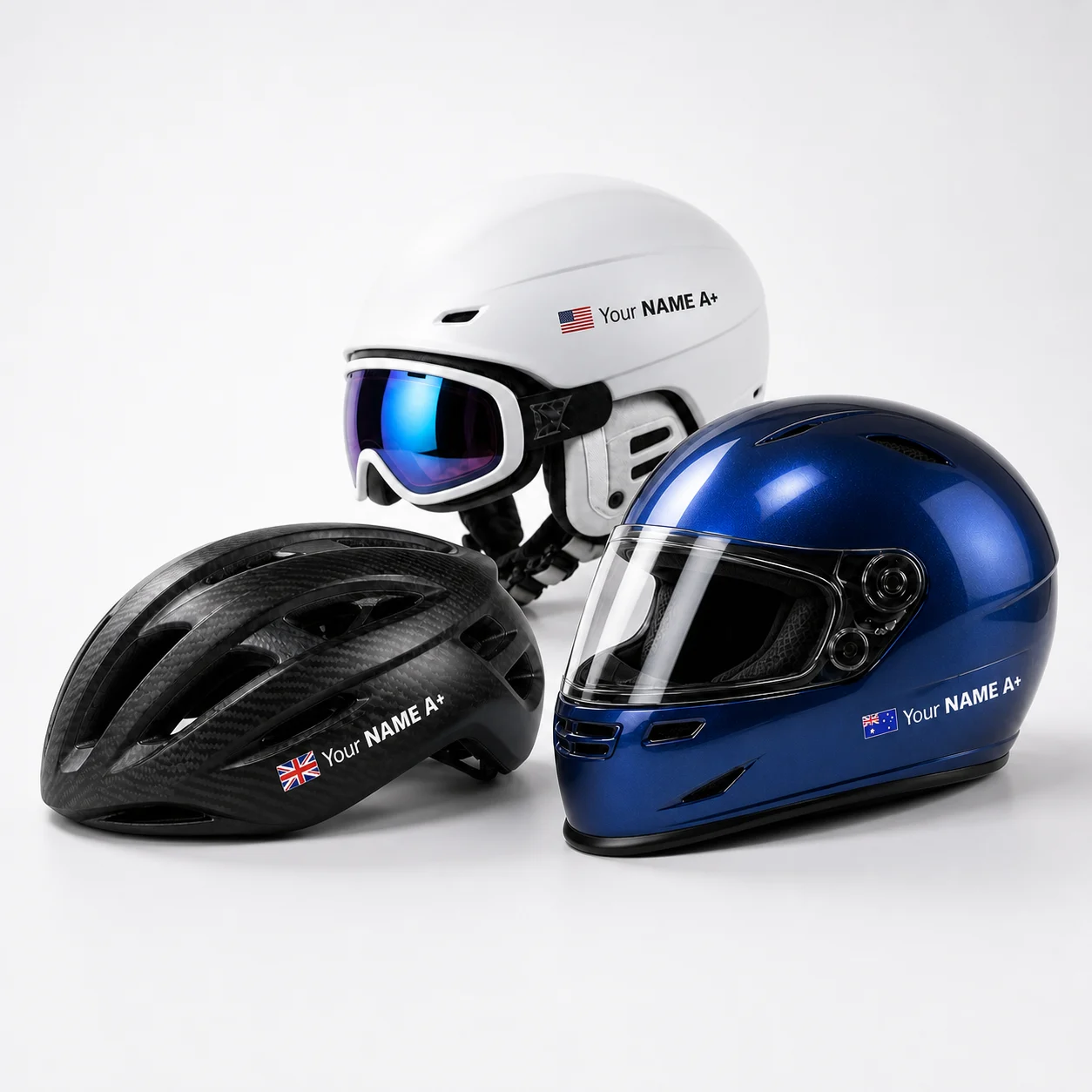
Suggested proportions by helmet type
| Helmet type | Best starting position | Recommended visual proportion |
|---|---|---|
| Cycling and road helmets | Side panel or rear quarter | About 50–60% of the usable panel width |
| MTB and BMX helmets | Side panel clear of visor and vents | About 50–65% of the usable panel width |
| Motorcycle and motorsport helmets | Lower side or rear quarter | About 55–70% of the usable panel width |
| Karting helmets | Side area below or behind the visor | About 55–65% of the usable panel width |
| Ski and snowboard helmets | Side panel above the ear area | About 50–65% of the usable panel width |
| Equestrian helmets | Smooth side section | About 45–60% of the usable panel width |
| Junior helmets | Side or rear panel with the least curvature | About 50–60% of the usable panel width |
These percentages are visual starting points, not safety specifications. Helmet geometry varies widely, even within the same sport. Always check the helmet manufacturer’s guidance before applying any adhesive decal.
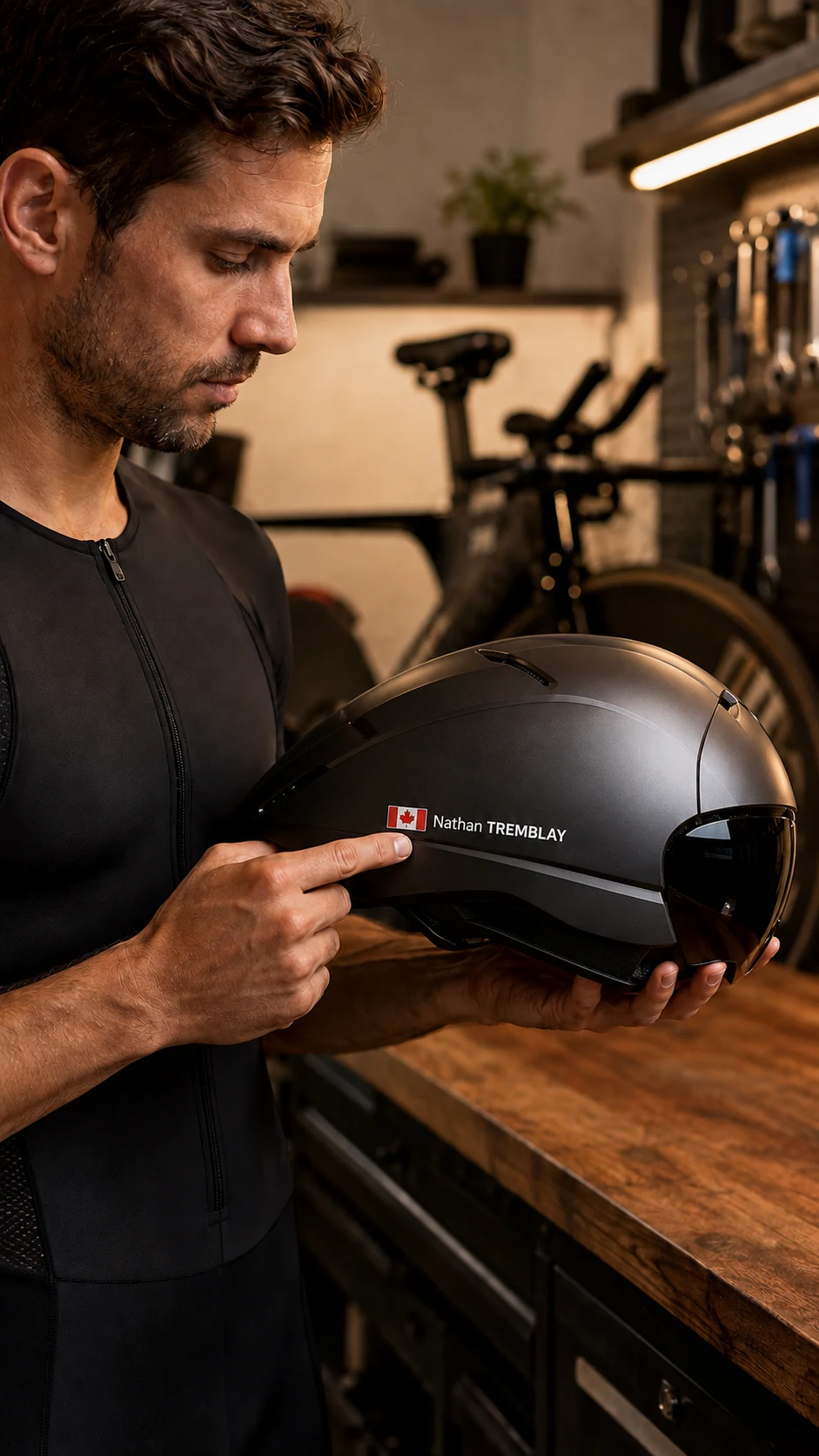
Choose the size for the name, not only the flag
A short name produces a shorter design, while a long surname needs more horizontal space. The letter height itself is fixed by the pack: 5 mm in BASIC and PRO, or 7 mm in PLUS. Measure the complete design—including the flag, first name, surname and any blood-group text—not just the text section.
For the characteristic Pegatin layout, the first name should use Open Sans Italic with only the first letter in uppercase. The surname should use Open Sans Bold in uppercase. This contrast creates a clean hierarchy and keeps the design recognisable at a glance.
Where should the sticker sit?
Cycling, MTB and BMX helmets
Look for a smooth side panel between vents. The decal should follow the main horizontal line of the helmet. Avoid bridging a vent or placing the sticker on a sharply recessed section. Riders using a full-face MTB or BMX helmet should also keep clear of visor screws, chin-bar openings and camera mounts.
See the dedicated guides for cycling helmet name stickers, mountain bike helmet stickers and BMX helmet name stickers.
Motorcycle, karting and racing helmets
Larger shells can accept a wider decal, but proportion still matters. The side or rear quarter often gives the best balance. Keep the design away from visor mechanisms, vents, air systems, intercom fittings, spoilers, homologation marks and safety information.
Compare the placement advice in our motorcycle helmet guide, karting helmet guide and rally helmet guide or our racing helmet name sticker guide.
Ski, snowboard and equestrian helmets
These helmets often have soft panels, textured areas or strong curves near the ear section. Use the smoothest shell area and leave the edge of the decal fully supported. Do not place it across a join between materials.
For sport-specific examples, visit the ski helmet sticker guide, snowboard helmet sticker guide and equestrian helmet sticker guide.
Black or white lettering?
Contrast is as important as physical size. Black lettering is usually clearer on white, silver and other light shells. White lettering works better on black, navy and darker colours. On a multicolour helmet, test both options against the exact panel where the sticker will sit.
A high-contrast compact sticker is often more readable than an oversized low-contrast design. PRO and PLUS include both black and white lettering. BASIC uses black lettering and suits light surfaces.
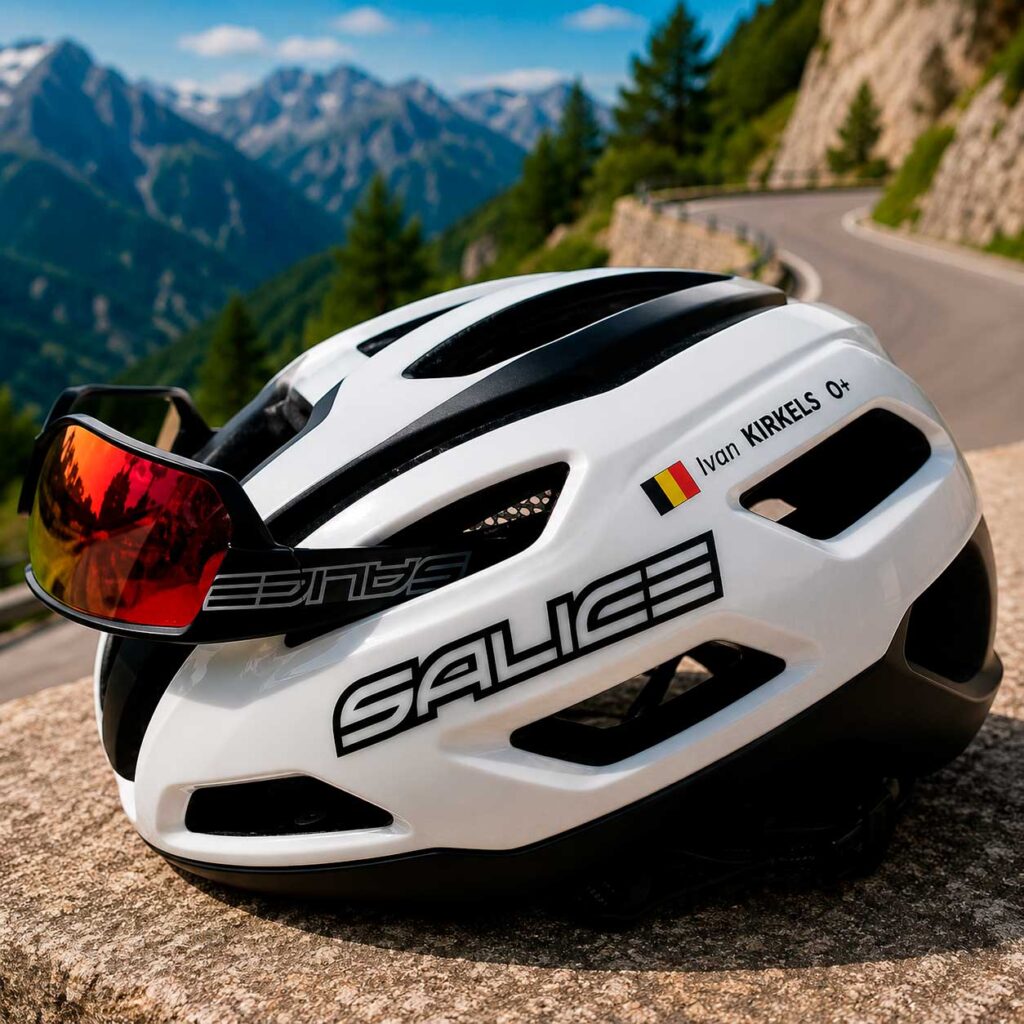
Avoid these common sizing mistakes
- Choosing by helmet size alone. Two helmets marked the same size can have very different usable panels.
- Covering vents or labels. A decal must not hide certification marks, warnings or helmet damage.
- Placing it on a strong curve. Excessive curvature can make the design look distorted and may reduce adhesion at the edges.
- Using the same size on every item. A sticker that suits a motorcycle helmet may overwhelm a cycling or junior helmet.
- Ignoring viewing distance. Equipment identification at events requires more visibility than a subtle decorative detail.
Safety first: check the manufacturer’s instructions
Only apply stickers to clean, smooth and suitable surfaces. Never use a decal to cover cracks, dents or other possible damage. Keep all certification labels, safety warnings, vents, mechanisms and inspection areas visible. If the manufacturer restricts adhesives or decals, follow its instructions. For example, the Bell powersports helmet manual prohibits decorative stickers and decals. Do not apply a Pegatin to a helmet covered by that restriction; choose another suitable item of equipment instead.
For more detail, read Is It Safe to Put a Sticker on a Helmet? and our sticker application and removal guide.
Find the right Pegatin for your sport
Choose between the two available Pegatin letter heights: 5 mm with BASIC or PRO, and 7 mm with PLUS. The correct pack fits the actual helmet, keeps every safety feature clear and makes the name and flag easy to recognise. Measure the usable panel and compare a paper template before ordering.
Explore the complete helmet sticker hub to find placement examples for cycling, motorsport, winter sports, team sports, climbing, kayaking and more.
Triathletes can also use our dedicated aero helmet sticker guide.