You’ve entered your first cycling sportive.
Now the questions start.
Am I fit enough? What should I take? How early should I arrive? What happens if I get a puncture? How much should I eat? Should I try to stay with a fast group?
Almost every cyclist asks the same things before their first organised event.
Fortunately, the good news is that a sportive doesn’t need to be intimidating.
With some sensible preparation, a reliable bike and a realistic approach to pacing, your first sportive can be one of the most enjoyable days you’ve had on two wheels.
Therefore, this guide covers everything you need to know before the start — from choosing your distance and preparing your bike to food, clothing, tools, group riding and the small details that make race day easier.
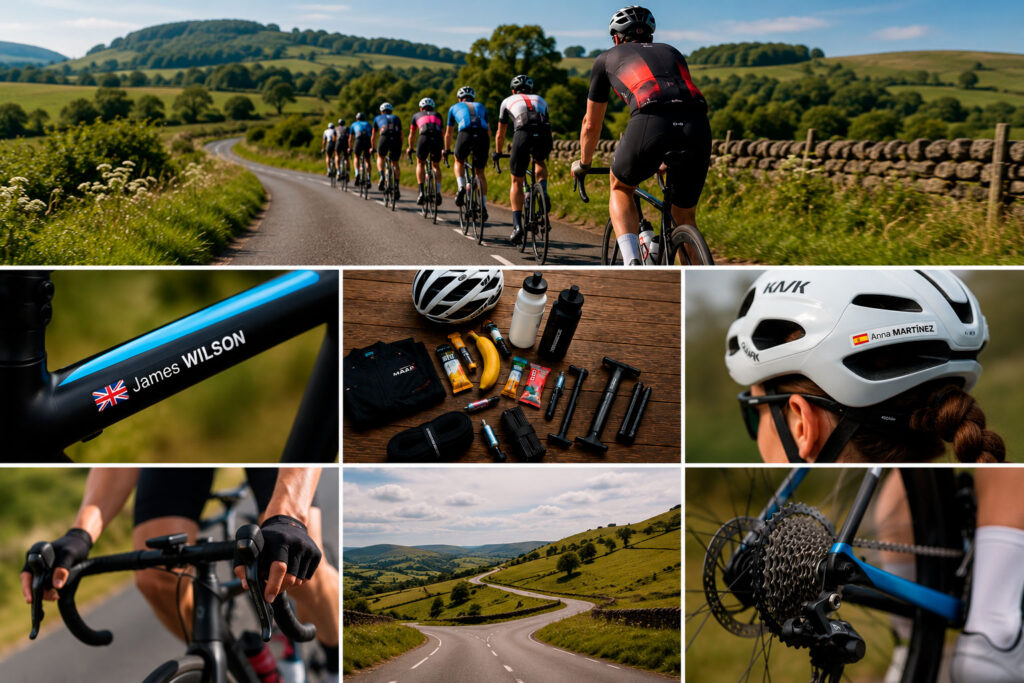
Personalise your bike for your next event — use code EVENT15 for 15% off
Make Your Bike Easy to Recognise
At a sportive, hundreds of bikes can look the same. Make yours unmistakably yours with a personalised name-and-flag Pegatin.
What Is a Cycling Sportive?
In simple terms, a cycling sportive is an organised mass-participation cycling event.
Unlike a traditional road race, the objective for most riders isn’t to beat everybody else.
Instead, it’s to complete a challenging route, enjoy riding with hundreds or thousands of other cyclists and test yourself over a distance that may be longer or harder than your normal weekend ride.
Sportives commonly include:
- a marked route;
- several distance options;
- timed results;
- feed stations;
- event photography;
- mechanical or medical support;
- a start and finish area with other cyclists.
For example, some take place on closed roads, while many use roads that remain open to normal traffic.
As a result, that means normal road awareness and safe riding still matter throughout the event.
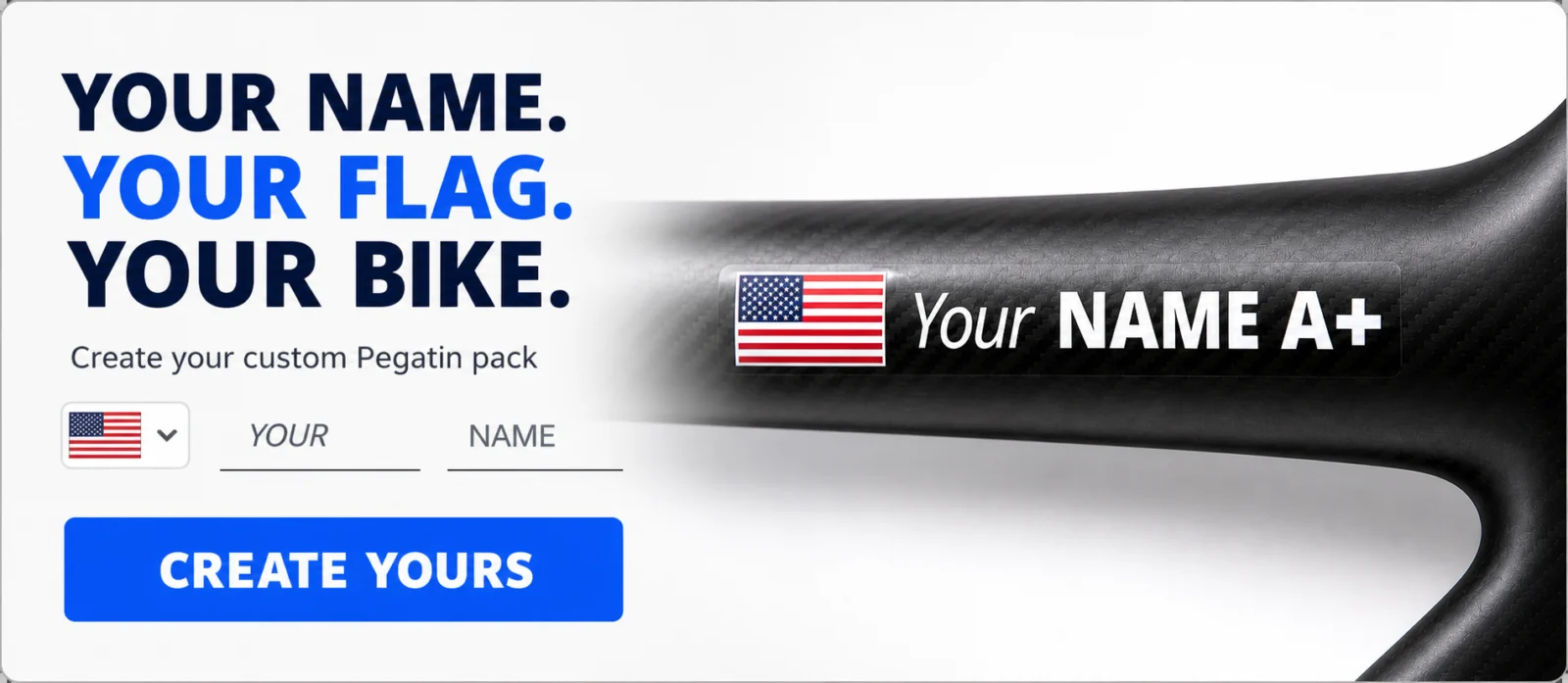
Make your bike easier to identify and give it a clean professional look.
How Long Should Your First Sportive Be?
However, there is no perfect first-sportive distance.
A good choice depends on:
- the longest rides you currently complete;
- route elevation;
- current riding frequency;
- available training time;
- whether your goal is simply to finish or to ride strongly.
If your normal weekend ride is 50–70 km, entering a 160 km sportive next week is probably not the smartest introduction.
On the other hand, your first sportive should feel like an achievement.
Instead, choose something that stretches you without turning the entire day into survival.
Typical options at UK events often include something close to:
- Short: 40–70 km
- Middle: 70–120 km
- Long: 120–160+ km
In addition, remember that distance is only half the story.
A hilly 100 km route can be considerably harder than a flatter 130 km ride.
Do You Need to Be Fast?
No.
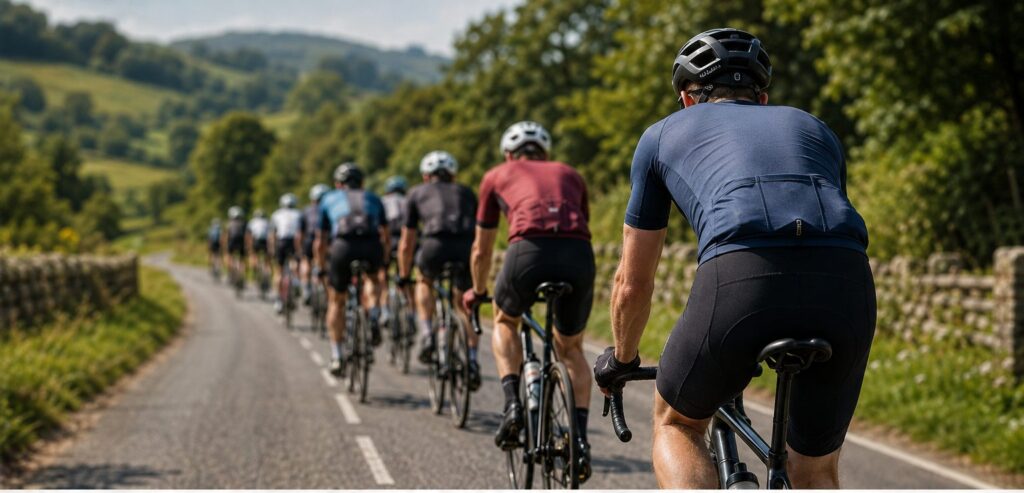
Importantly, a sportive is not reserved for elite cyclists.
Instead, what matters far more is being able to ride at a sustainable pace for the distance you have entered.
Before choosing an event, check:
- minimum average-speed requirements if there are any;
- course closing times;
- elevation;
- cut-off times;
- the organiser’s difficulty rating.
Your objective for a first sportive should be simple:
finish comfortably enough that you want to enter another one.
How Much Training Do You Need?
For example, you don’t need to reproduce the full sportive distance every weekend.
But you should become comfortable spending several hours on the bike.
Build gradually.
A simple progression might look like:
Week 1: normal training
Week 2: slightly longer endurance ride
Week 3: add distance or climbing
Week 4: easier recovery week
Week 5: longer endurance ride
Week 6: event-specific training
Week 7: final long ride
Event week: reduce volume and arrive fresh
Ultimately, the exact plan depends on your current fitness and the event.
What matters is avoiding two classic mistakes:
doing too little, then hoping adrenaline will carry you through;
or
doing too much immediately before the event, then arriving tired.
Practice Eating on the Bike
Moreover, one of the biggest differences between a normal club ride and a long sportive is nutrition.
You may be riding for several hours.
Your body needs fuel.
Do not wait until sportive day to discover:
- which gels you tolerate;
- whether solid food works better for you;
- how much carbohydrate drink you like;
- where you will carry everything;
- whether you can open your food while riding.
Therefore, use your long training rides as rehearsals.
Above all, race-day nutrition should be familiar.
What Should You Eat Before a Sportive?
For instance, eat a breakfast that you know works for you.
However, avoid turning event morning into an experiment.
A familiar breakfast containing carbohydrates and enough fluid is generally a better idea than suddenly eating something completely different because another cyclist recommended it.
Finally, give yourself time to digest.
And remember:
breakfast does not replace eating during a long event.
The Complete First Sportive Checklist
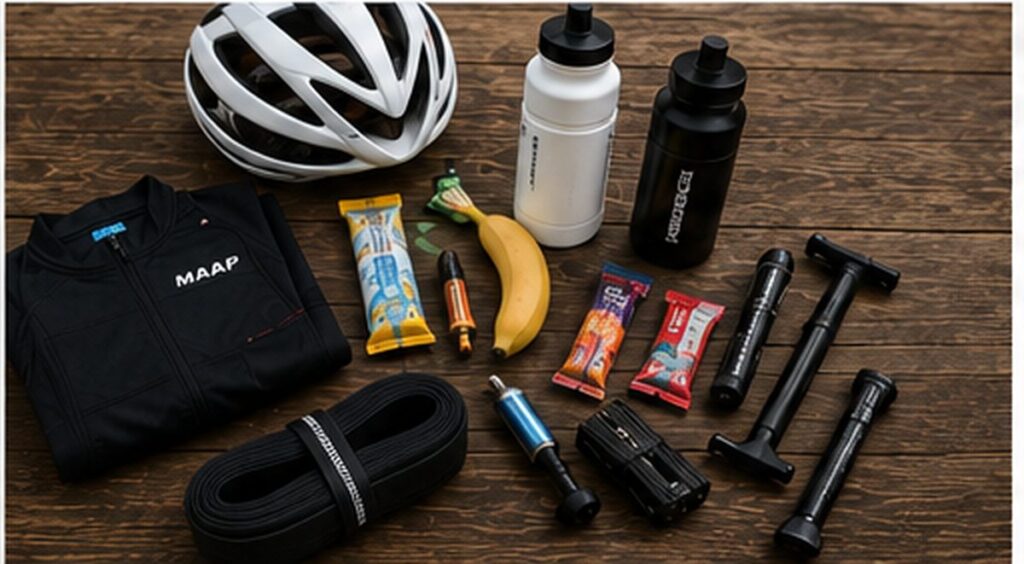
Save this section and check it again the night before.
Cycling kit
- helmet;
- jersey;
- bib shorts;
- socks;
- cycling shoes;
- gloves if you use them;
- sunglasses;
- base layer if conditions require one;
- gilet or lightweight jacket;
- arm or leg warmers depending on weather.
Your helmet is also one of the most useful places for personal identification. If you’ve never considered it, read our guide to putting your name and flag on your cycling helmet.
Nutrition
- energy bars;
- gels if you use them;
- familiar real food;
- electrolyte or carbohydrate mix;
- filled bottles;
- extra food for before or after the ride.
Mechanical kit
- spare inner tube or tubeless repair kit;
- tyre levers;
- mini pump or CO₂ inflator;
- multitool;
- compatible chain quick-link;
- small saddle bag.
Personal essentials
- mobile phone;
- payment card;
- emergency cash;
- identification;
- keys;
- event confirmation if required;
- medication you normally carry.
Electronics
- cycling computer;
- charged phone;
- front/rear lights if required;
- heart-rate monitor if used;
- electronic gears charged;
- power meter checked.
Prepare Your Bike Several Days Before
The evening before your first sportive is not the time to discover that your rear brake is rubbing.
Do your main bike check several days earlier.
Check the tyres
Inspect for:
- cuts;
- excessive wear;
- embedded debris;
- correct pressure;
- tubeless sealant level.
Check the brakes
Make sure braking is smooth and predictable.
Check pad wear.
Check the drivetrain
Clean and lubricate the chain.
Run through every gear.
Listen for anything unusual.
Check the bike’s contact points
Make sure the following haven’t moved:
- saddle;
- seatpost;
- handlebars;
- cleats.
Check accessories
Make sure these are secure:
- bottle cages;
- computer mount;
- lights;
- saddle bag.
Then ride the bike.
A short test ride after maintenance is much more valuable than staring at it in the garage and assuming everything is fine.
Don’t Make Big Changes Immediately Before the Event
New saddle?
Different cleat position?
Completely different shoes?
Fresh bike fit?
Major equipment changes should be tested before the sportive.
Something can feel perfectly comfortable for twenty minutes and become unbearable after four hours.
If your setup already works, event week is not the moment to reinvent it.
Check the Weather at the Right Time
UK weather can change quickly.
A forecast seven days before your sportive is useful.
The forecast the evening before is much more useful.
Prepare options rather than carrying everything you own.
Depending on conditions, useful additions might include:
- packable gilet;
- rain jacket;
- arm warmers;
- lightweight gloves;
- overshoes.
The goal is to be prepared without filling every jersey pocket with emergency clothing.
Arrive Earlier Than You Think You Need To
Event mornings take longer than expected.
You may need to:
- park;
- unload the bike;
- register;
- attach your number;
- visit the toilet;
- fill bottles;
- check tyre pressures;
- put food in your pockets;
- find your start area.
Give yourself time.
You should be on the start line thinking about the ride ahead — not wondering where you left your gloves.
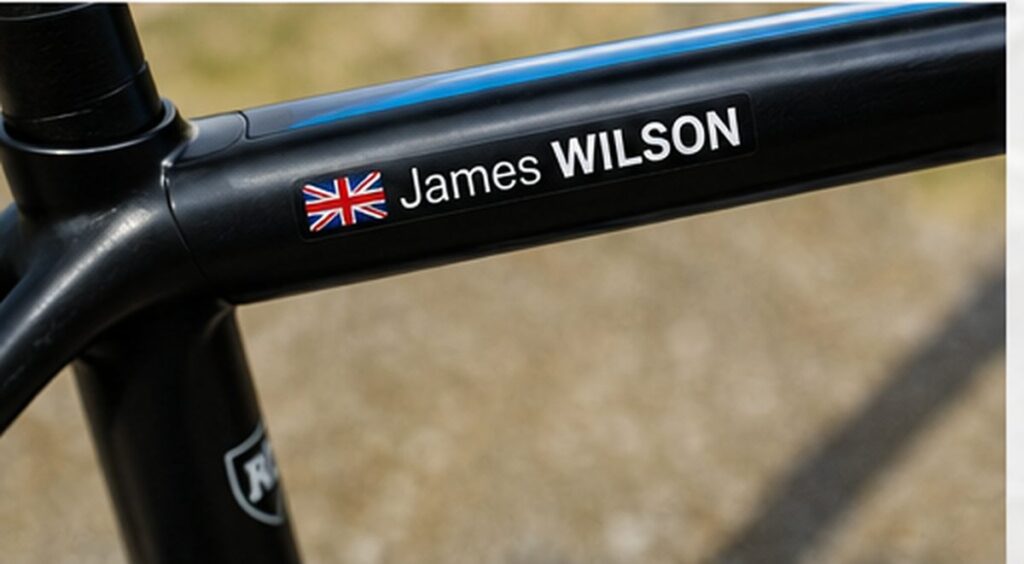
Make Your Bike Yours
Add your name and national flag to your bike and give it the same clean finishing detail seen on professional race bikes.
10 personalised stickers · Black + white versions · Worldwide shipping included
How Should You Pace Your First Sportive?
This is where excitement causes problems.
Hundreds of cyclists start together.
Everyone feels fresh.
Fast groups come past.
You feel amazing.
So you ride considerably harder than planned.
Three hours later, you discover why that was a bad idea.
Start Conservatively
The opening section should feel almost too easy.
Your effort should be sustainable.
If you’re riding 100 km or more, the question isn’t:
Can I follow this group for the next ten minutes?
It’s:
Can I ride at this effort several hours from now?
If the answer is uncertain, back off.
Don’t Chase Every Group
Drafting behind other riders can save energy, so finding a suitable group is useful.
But it has to be the right group.
If a group is riding above your sustainable pace, letting it go is not failure.
Another group will come along.
Your first sportive is about completing your ride, not proving something in the first 15 kilometres.
Group Riding Etiquette
Sportives often put riders of very different experience levels together.
Be predictable.
Avoid sudden movements
Don’t suddenly change line without checking.
Signal hazards
Point out potholes, debris and obstacles when appropriate.
Don’t overlap wheels
Give the rider ahead enough space.
Look ahead
Don’t stare exclusively at the rear wheel directly in front of you.
Ride within your ability
If you’re uncomfortable in a tight group, increase your distance.
Safe, smooth riding matters more than saving a few watts.
Make Sure Your Bike Is Easy to Identify
Sportive start areas can contain hundreds of remarkably similar bicycles.
Canyon in black.
Specialized in black.
Trek in black.
Cervélo in black.
Another black Canyon.
A very small detail can make your bike unmistakably yours:
your name and national flag on the top tube.
This is the same rider-identification detail commonly seen on professional race bikes.
If you’ve ever wondered why it exists in professional cycling, read our guide to why professional cyclists put their name and flag on the top tube.
For amateur riders, the benefit is straightforward:
it identifies your bike and gives it a clean professional finishing touch.
At a large sportive, where hundreds of bikes may be parked together or lined up before the start, that small detail can also make yours much easier to recognise.
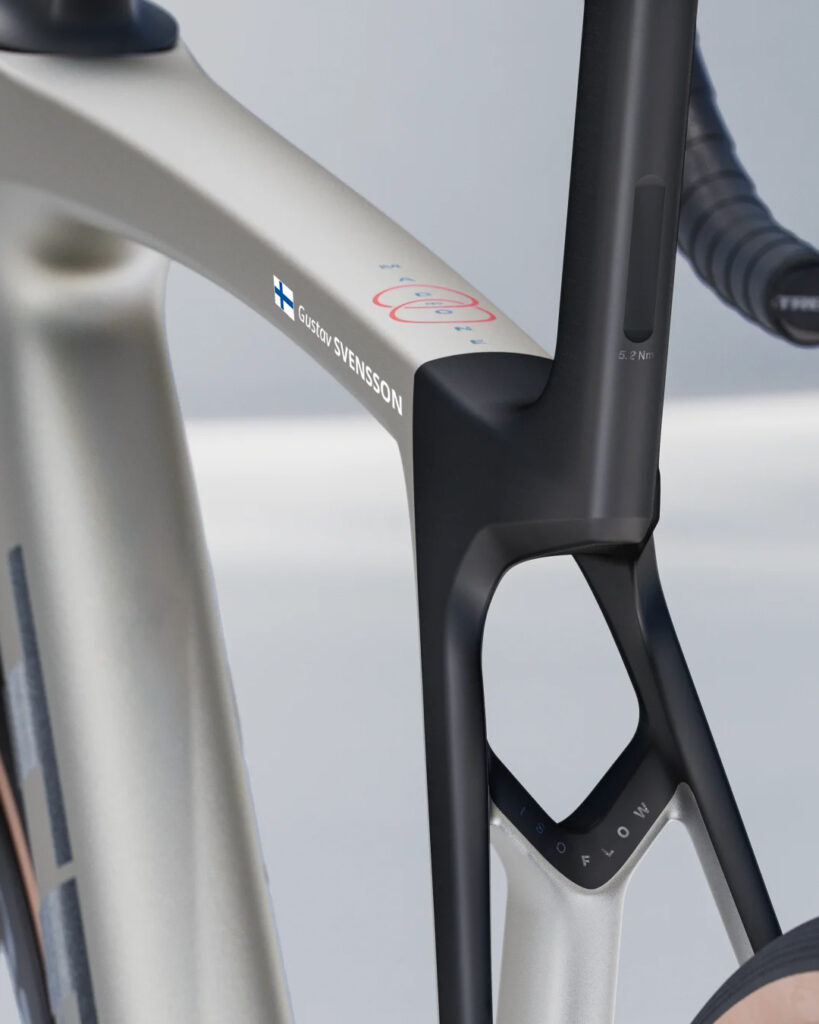
Get the PRO Look
Your bike already says a lot about you. Add the final detail: your name + your flag.
Which Pegatin Pack Is Best for Your Bike?
The best option depends on the colour and finish of your frame.
Pegatin offers BASIC, PRO and PLUS.
If you’re unsure which one you need, see our complete comparison:
Pegatin BASIC vs PRO vs PLUS: Which Pack Should You Choose?
The PRO and PLUS options give you both black and white versions, which makes them particularly useful if you want to use the same personalised identity across different light and dark surfaces.
That means your name and flag can work across:
- your top tube;
- your helmet;
- other suitable cycling equipment.
Create your personalised Pegatin here.
What Should You Put on Your Personalised Bike Sticker?
The classic professional combination is simple:
national flag + first name + surname.
It’s clean, immediately recognisable and doesn’t overpower the design of the bike.
Choose a black or white version that contrasts with your frame, and keep the placement discreet.
If you’re deciding what to write, see our guide to what to put on your personalised bike sticker beyond just your name.
Where Should You Put a Name Sticker on Your Bike?
The classic professional position is the top tube.
Keep it subtle.
Before applying the sticker:
- clean the surface;
- remove grease and dirt;
- dry completely;
- check alignment;
- apply carefully.
If you want the complete process, read our step-by-step guide to applying and removing custom bicycle stickers.
Will a Sticker Damage a Carbon Frame?
A premium carbon bike is an expensive piece of equipment, so this is a reasonable concern.
Correct application and removal matter.
If you have a carbon frame — particularly one with a special or matte finish — read our detailed guide:
Do Stickers Damage Your Carbon Frame? What Every Cyclist Should Know
Put Your Name on Your Helmet Too
A cycling helmet is another useful place for rider identification.
At a crowded sportive, club event or training camp, a small name-and-flag sticker can make your equipment easier to identify and create a consistent bike-and-rider look.
It’s also one of the most visible pieces of equipment when you’re actually riding.
See our complete guide to putting your personalised name and flag on a cycling helmet.
Riding With Your Club?
Sportives are often more enjoyable with friends.
If several club members are taking part, individual name-and-flag stickers can give the group a consistent visual identity while keeping every rider’s equipment easy to distinguish.
See our guide to matching personalised name stickers for cycling clubs and teams.
New Forest Tour: A Previous-Edition Example
The New Forest Tour 2026 took place on 19–20 September. Our previous-edition guide offers an example of event preparation; check the organiser’s current information before planning a future ride.
Read our New Forest Tour 2026 guide.
The Night-Before Checklist
By the night before, most decisions should already be made.
Bike
✓ tyres checked
✓ brakes checked
✓ drivetrain running correctly
✓ bottles ready
✓ repair kit installed
✓ computer charged
✓ electronic gears charged
Clothing
✓ helmet
✓ jersey
✓ bib shorts
✓ shoes
✓ socks
✓ sunglasses
✓ weather layer
Food
✓ breakfast planned
✓ ride nutrition packed
✓ bottles prepared
✓ post-event food if needed
Personal
✓ phone
✓ wallet/card
✓ ID
✓ keys
✓ event details
Logistics
✓ start location
✓ parking
✓ registration time
✓ start wave
✓ route downloaded if available
✓ alarm set
Then stop preparing.
Get some sleep.
During the Ride
Your priorities are simple.
Pace Yourself
Don’t spend everything in the first hour.
Eat
Start before you’re starving.
Drink
Take regular fluids.
Pay Attention
Roads may remain open to traffic.
Communicate
Be predictable around other riders.
Enjoy It
You paid to be there.
Look around occasionally.
What Happens If You Have a Bad Day?
Not every sportive goes perfectly.
You may:
- feel slower than expected;
- have mechanical trouble;
- get bad weather;
- miss your nutrition;
- suffer cramps;
- choose a route that’s too ambitious.
None of that makes the day worthless.
Your first sportive teaches you things that training rides cannot.
You’ll learn:
- what you actually need to carry;
- what you don’t need;
- how your body responds after several hours;
- whether your bike setup works;
- which food suits you;
- how comfortable you are riding in groups.
The second sportive is usually easier because you know what to expect.
After the Finish
Eat.
Drink.
Put on dry clothing if necessary.
Take your finisher photo.
Look at the bike you’ve just spent hours riding.
And enjoy the fact that you did it.
If you’re already thinking about the next one, your first sportive has probably gone exactly as it should.
First Cycling Sportive FAQ
What is a cycling sportive?
A sportive is an organised mass-participation cycling event, usually held over a marked route with one or more distance options. Many are timed, but most riders take part to challenge themselves rather than race for position.
Do I need a road bike for a sportive?
Not always. The correct bike depends on the event and route rules. For a typical road sportive, a well-maintained road bike, endurance bike or suitable fast hybrid may be acceptable. Always check the organiser’s rules.
How far should my first sportive be?
Choose a distance that provides a challenge without being dramatically beyond your current training. Consider both distance and elevation rather than kilometres alone.
What should I carry during a sportive?
At minimum, consider food, fluids, phone, identification, payment method and basic repair equipment including a spare tube or tubeless repair kit, tyre levers, pump or CO₂ and multitool.
Are cycling sportives races?
Many sportives are timed, but they are generally mass-participation challenge events rather than conventional road races. Check the specific organiser’s rules because formats vary.
Should I stop at the feed stations?
For most riders, yes. Feed stations are useful for refilling bottles, taking on food and briefly recovering. You should still carry some familiar nutrition yourself.
Should I put my name on my bike for a sportive?
It isn’t required, but a small personalised name-and-flag sticker makes your bike easier to recognise among similar bicycles and adds the rider-identification detail commonly seen on professional race bikes.
Which Pegatin should I use?
The best option depends on the colour and finish of your bike. Compare BASIC, PRO and PLUS here before ordering.
Final Advice for Your First Sportive
You don’t need to be the fastest rider or own the most expensive bike. Instead, you need:
a reliable bike, realistic pacing, enough food, enough water and a little preparation.
Then enjoy the day.
A first sportive has a strange habit of becoming a second one.
And once you’re lining up with hundreds of other cyclists, there’s something particularly satisfying about looking down at the top tube and seeing your own name and flag there.
Your bike, name and ride.
Create your personalised Pegatin and get the PRO look.
Looking for the perfect event to ride next? Explore our cycling events 2027 calendar to discover gran fondos, sportives and endurance rides around the world.
Personalise your bike for your next event — use code EVENT15 for 15% off