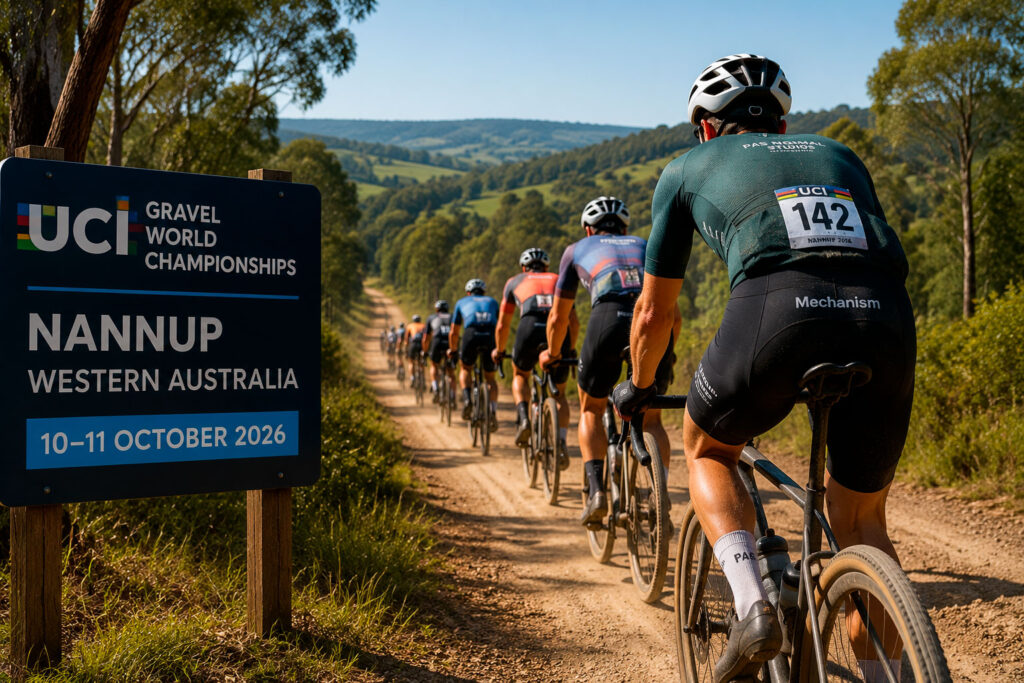
Personalise your bike for your next event — use code EVENT15 for 15% off
The gravel world is heading to Western Australia.
On 10–11 October 2026, Nannup will host the UCI Gravel World Championships, bringing qualified amateur age-group riders and some of the world’s best gravel racers together for one of the biggest events on the 2026 cycling calendar.
For riders, it is the culmination of an entire season of racing and qualification.
For fans, it is a rare opportunity to see world-class cycling on the gravel roads of Western Australia.
And for anyone planning to race, travel to Nannup or simply follow the event, preparation matters.
This guide covers what we know about the 2026 championships, how qualification works, what kind of bike and equipment you should think about and how to prepare for a major gravel event.
When Are the 2026 UCI Gravel World Championships?
The 2026 UCI Gravel World Championships will take place on 10 and 11 October 2026 in Nannup, Western Australia.
In addition, the UCI calendar officially lists Nannup as host of the championships for that weekend.
Overall, it will be the fifth edition of the UCI Gravel World Championships.
Make your bike easier to identify and give it a clean professional look.
Where Is Nannup?
Nannup is a small town in Western Australia surrounded by forests, rolling terrain and an extensive network of unsealed roads.
It already has a strong connection to gravel racing.
Since 2018, the town has hosted The SEVEN, which has become an established event on the UCI Gravel World Series calendar.
Consequently, that experience makes Nannup a natural venue for a world championship built around gravel terrain.
Why Is Nannup Hosting the Gravel World Championships?
Meanwhile, the UCI Gravel World Series has expanded rapidly.
For 2026, the series includes 47 qualifying events across 32 countries and five continents.
Therefore, riders qualifying through those events will converge on Nannup to compete for world championship titles.
That means the event will bring together riders from an unusually wide range of countries, experience levels and cycling cultures.
For Pegatin, that’s exactly the kind of event where rider identity matters.
At the event, hundreds of athletes will arrive with bikes that may look very similar.
A small name-and-flag sticker on the top tube is one of the simplest ways to make a bike instantly identifiable.
In addition, it’s a detail closely associated with professional racing.
If you’re curious about why pro riders use them, read our guide to why professional cyclists put their name and flag on the top tube.
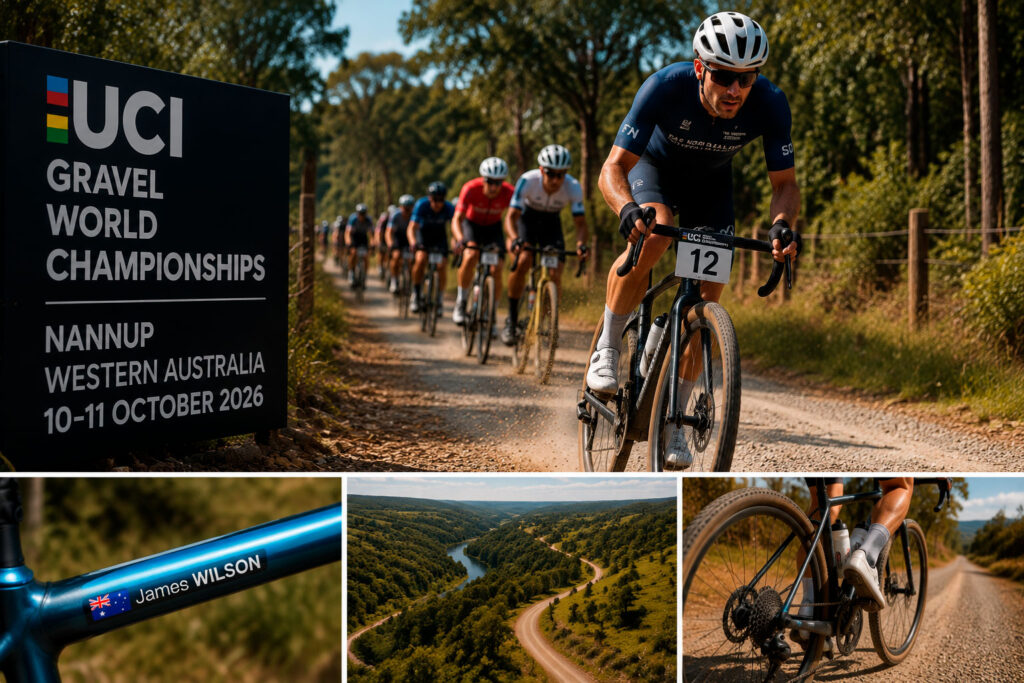
Make Your Gravel Bike Unmistakably Yours
Thousands of bikes. One name.
A personalised flag + name sticker makes your bike easy to recognise at races, sportives and group rides.
✓ Transparent sticker
✓ Black & white versions available
✓ Worldwide shipping included
👉 Get Your PegatinPRO Pack → https://pegatin.com/
How Do You Qualify for the UCI Gravel World Championships?
In practice, the UCI Gravel World Series acts as the qualification pathway for the championships.
Specifically, the 2026 calendar includes 47 qualifying events around the world.
Accordingly, riders qualify through their performance in an eligible event and their respective category.
However, the exact qualification rules depend on the category and UCI regulations, so riders should always verify the latest requirements directly with the UCI before making travel arrangements.
In other words, the important point is that the World Championships are not simply a normal open-entry gravel race.
For many age-group competitors, therefore,, earning a place in Nannup will already be a significant achievement.
What Makes Gravel Racing Different?
Gravel racing sits somewhere between road cycling and mountain biking.
Depending on the course, riders may encounter:
- fast compact gravel;
- loose surfaces;
- rough forestry roads;
- short technical sections;
- steep climbs;
- corrugations;
- sand;
- exposed sections;
- rapid changes between surfaces.
As a result, this creates a unique equipment challenge.
Therefore, a gravel bike needs to be fast enough for long open sections while still offering control, durability and comfort when the surface becomes rough.
What Bike Do You Need for a Gravel World Championship?
However, there is no single perfect gravel bike.
Instead, the right setup depends on the course and conditions.
But for a major gravel race, most riders will care about:
- tyre clearance;
- tyre choice;
- gearing;
- braking;
- bike weight;
- comfort;
- reliability.
Tyres
For example, tyre choice may be one of the most important setup decisions.
However, the fastest tyre in perfect conditions is useless if it leaves you fixing punctures at the side of the course.
Consider:
- width;
- tread pattern;
- casing protection;
- tubeless compatibility;
- expected surface;
- weather.
Do not make your first ride on a new tyre race day.
Test it beforehand.
Tubeless or Inner Tubes?
Many gravel racers favour tubeless setups because they can reduce the risk of pinch flats and allow lower pressures.
But tubeless systems also need preparation.
Before the event:
- check sealant;
- inspect tyres;
- verify valves;
- carry plugs;
- carry inflation;
- consider an emergency tube.
Whatever system you use, know how to repair it.
What Tyre Pressure Should You Use?
There is no universal gravel tyre pressure.
It depends on:
- rider weight;
- tyre width;
- rim width;
- tyre construction;
- terrain;
- speed;
- weather.
Use a reputable pressure calculator as a starting point and then test the setup on similar terrain.
The correct pressure should provide a balance between:
speed + traction + comfort + puncture resistance.
What Gearing Should You Use?
Gravel courses can punish riders who choose gearing based purely on speed.
If Nannup includes sustained or steep climbing, having an easier climbing gear can save significant energy late in the race.
Your gearing should match:
- available power;
- preferred riding style;
- expected gradient;
- course surface.
A gear that feels unnecessary during a fresh training ride can become extremely useful several hours into a race.
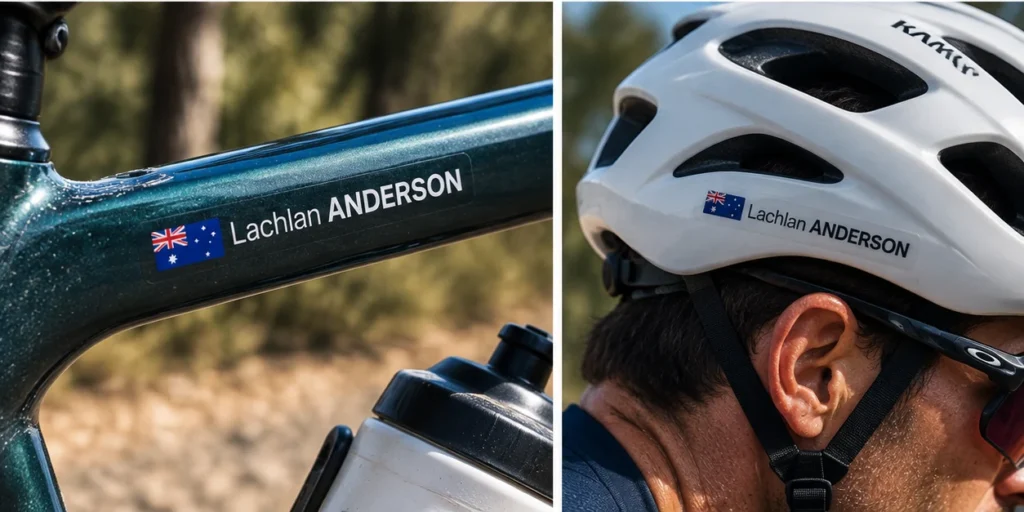
Race Like a Pro. Look Like a Pro.
The world’s biggest gravel events are about more than speed.
Your bike is part of your story.
Add your name + national flag and give your bike the professional finishing detail seen in elite racing.
🚴 Create your personalised PegatinPRO
Prepare Your Bike Before Travelling
A World Championship is not the place to discover a mechanical issue.
Several days before travel, check:
Drivetrain
- chain wear;
- cassette;
- chainrings;
- derailleur adjustment;
- electronic shifting charge if applicable.
Brakes
- pad wear;
- rotor condition;
- braking consistency.
Wheels
- spoke tension;
- bearings;
- rim condition;
- tubeless tape.
Tyres
- cuts;
- wear;
- sealant;
- pressure;
- valve condition.
Contact Points
- saddle;
- handlebars;
- bar tape;
- pedals;
- cleats.
Then ride the exact race setup.
Don’t simply build the bike and put it in a travel case.
Travelling With Your Gravel Bike
If you’re flying to Western Australia, your bike will be one of the most important pieces of luggage you own that week.
Before packing:
- photograph the bike;
- photograph existing marks;
- protect the frame;
- protect brake rotors;
- secure loose components;
- protect the derailleur;
- mark the bike case clearly.
Personal identification becomes particularly useful when travelling to international cycling events.
A personalised name-and-flag sticker can be used not only on the bike but also on suitable cycling equipment and cases.
If you’re deciding which version works best for your bike, see our comparison of Pegatin BASIC, PRO and PLUS.
Make Your Bike Easy to Identify in Nannup
World Championship events bring together huge numbers of premium bikes.
Canyon.
Specialized.
Trek.
Cervélo.
Factor.
Pinarello.
Scott.
BMC.
And many others.
After a while, very expensive bicycles start looking remarkably similar.
A personalised flag + first name + surname on the top tube immediately solves that problem.
It also gives the bike the same finishing detail that riders associate with professional racing.
For a world-level amateur event, that feels particularly appropriate.
Create your personalised Pegatin here.
Which Pegatin Pack Is Best for a Gravel Bike?
The answer depends on the colour and finish of your frame.
Pegatin offers BASIC, PRO and PLUS versions.
If you’re unsure which version suits your bike, read our full guide:
Pegatin BASIC vs PRO vs PLUS: Which Pack Should You Choose?
In particular, the PRO and PLUS options are especially useful for riders using both light and dark equipment because they include black and white versions.
As a result, this makes it easier to keep the same rider identity across:
- bike;
- helmet;
- equipment;
- travel gear.
Will a Sticker Damage a Carbon Gravel Bike?
Because many high-end gravel bikes use carbon frames, so this is a common concern.
Therefore, correct application and removal are important.
If you’re unsure about using a sticker on your carbon frame, read our guide:
Do Stickers Damage Your Carbon Frame? What Every Cyclist Should Know
And for installation and removal, see our step-by-step bicycle sticker application guide.
Put Your Name on Your Helmet Too
Likewise, at a major international event, your helmet is another natural place for identification.
For example, a small name-and-flag sticker creates a consistent visual identity between rider and bike.
In addition, it can make you easier to recognise:
- at the start;
- in photographs;
- around team areas;
- during training;
- when equipment is stored with other riders’ gear.
See our complete guide to putting your name and flag on your cycling helmet.
What Should You Carry During a Gravel Race?
Of course, your exact equipment depends on the rules and course.
But gravel riders commonly consider carrying:
- tubeless plugs;
- spare tube;
- tyre levers;
- CO₂ or mini pump;
- multitool;
- chain quick-link;
- food;
- bottles or hydration pack;
- phone if permitted and useful;
- identification.
The balance is always:
carry enough to survive common problems without carrying your entire workshop.
Nutrition for a Long Gravel Race
Moreover, gravel racing can be physically demanding because rough surfaces increase muscular fatigue even when average speed is lower than on the road.
Therefore, practise your nutrition strategy before race day.
You should already know:
- which foods work;
- where you’ll carry them;
- when you’ll eat;
- how you’ll drink;
- whether you can eat safely on rough terrain.
Above all, don’t introduce completely new nutrition at a World Championship.
Pacing a Major Gravel Race
At first, the start of a gravel race can be aggressive.
Consequently, position matters because loose terrain, bottlenecks and narrow sections can make passing difficult.
But there is still a trade-off.
However, going far beyond your sustainable effort in the first hour can destroy the second half of your race.
Know what your event means to you.
Are you trying to:
- compete for position;
- achieve a target time;
- beat your previous performance;
- finish a World Championship?
Ultimately, your pacing strategy should match your objective.
Practice Riding Rough Surfaces
However, road fitness alone does not make someone a good gravel racer.
Handling matters.
Train on surfaces that force you to practise:
- braking;
- cornering;
- descending;
- choosing lines;
- riding loose gravel;
- staying relaxed on rough terrain.
For example, one of the most useful gravel skills is learning not to fight the bike.
Stay loose.
Instead, let the bike move beneath you.
Do You Need a Gravel-Specific Helmet?
Finally, use a helmet that meets the relevant event and safety requirements and fits you correctly.
The most important things are:
- correct fit;
- secure retention system;
- comfort;
- ventilation;
- familiarity.
Race day is not the best time to test a helmet you’ve never worn for several hours.
If you’d like to add personal identification, see our guide to personalised cycling helmet name stickers.
What to Do the Day Before the Race
Do less than you think.
Your work is done.
Bike
✓ tyres checked
✓ sealant checked
✓ drivetrain ready
✓ brakes ready
✓ computer charged
✓ race number prepared
✓ repair kit installed
Rider
✓ helmet
✓ shoes
✓ kit
✓ glasses
✓ gloves
✓ nutrition
✓ bottles
Logistics
✓ start location
✓ start time
✓ route
✓ registration information
✓ transport plan
Then stop.
Eat.
Hydrate normally.
Sleep.
What Makes the 2026 Gravel Worlds Special?
Overall, the scale of the qualification series tells the story.
Specifically, the 2026 UCI Gravel World Series contains 47 qualifying events across 32 countries on five continents.
As a result, that creates a genuinely international field.
For many amateur riders, simply reaching Nannup will represent months of training, racing and preparation.
Still, a World Championship doesn’t have to mean that you’re a full-time professional.
For an age-group rider, qualifying and lining up in your national colours can be one of the biggest moments of your cycling life.
In fact, that’s exactly when small details matter.
Therefore, your bike and helmet can display your national flag and name.
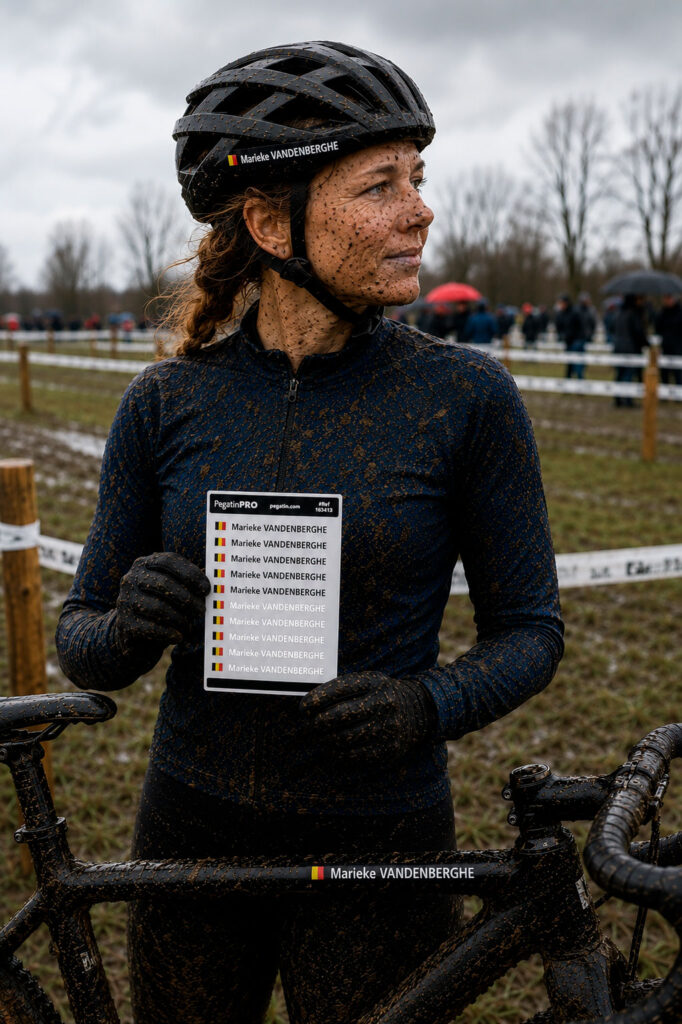
Bike, Name and Flag: One Rider Identity
Ultimately, from Nannup to your local gravel event, every rider has a story.
For instance, show yours with a personalised Pegatin featuring your national flag and name.
Then, join thousands of cyclists worldwide who have added the PRO look to their bikes.
👉 Design Your Pegatin Today → https://pegatin.com/
UCI Gravel World Championships 2026 FAQ
When are the 2026 UCI Gravel World Championships?
First, the championships are scheduled for 10–11 October 2026.
Where will the 2026 Gravel World Championships take place?
Specifically, they will take place in Nannup, Western Australia.
How do riders qualify?
Next, riders can qualify through eligible events in the UCI Gravel World Series. Always check the latest UCI regulations for the precise qualification requirements for your category.
How many qualifying events are there in 2026?
In fact, the UCI says the 2026 Gravel World Series includes 47 qualifying events in 32 countries across five continents.
Is Nannup already a gravel racing venue?
Yes. Moreover, Nannup has hosted The SEVEN since 2018 and is already established on the UCI Gravel World Series calendar.
What bike should I use?
However, the ideal setup depends on the final course and conditions. Tyres, gearing, braking, reliability and comfort are all important considerations.
Should I use tubeless tyres?
For example, many gravel racers choose tubeless systems, but the right choice depends on your setup and experience. Whatever system you use, practise repairing punctures before race day.
Can I put my name and flag on my gravel bike?
Yes. In addition, a small personalised name-and-flag sticker on the top tube is a simple way to identify your bike and give it the professional rider-identification look commonly seen in racing.
Which Pegatin pack should I choose?
Finally, it depends on your frame colour and finish. Compare BASIC, PRO and PLUS here.
Final Thoughts
In short, the UCI Gravel World Championships are no ordinary weekend ride.
For many riders, therefore, Nannup will be the end point of an entire season.
Qualification.
Training.
Travel.
Equipment.
Race day.
Above all, make sure the details don’t become the reason your experience is harder than it needs to be.
Prepare your bike.
Test your equipment.
Know your nutrition.
Know your race.
And when you finally line up in Western Australia, make sure the bike underneath you feels unmistakably yours.
Your bike, name and flag.
Create your personalised Pegatin and get the PRO look.
Planning beyond Nannup? Compare major gran fondos, sportives and endurance rides in our 2027 cycling events calendar.
Personalise your bike for your next event — use code EVENT15 for 15% off