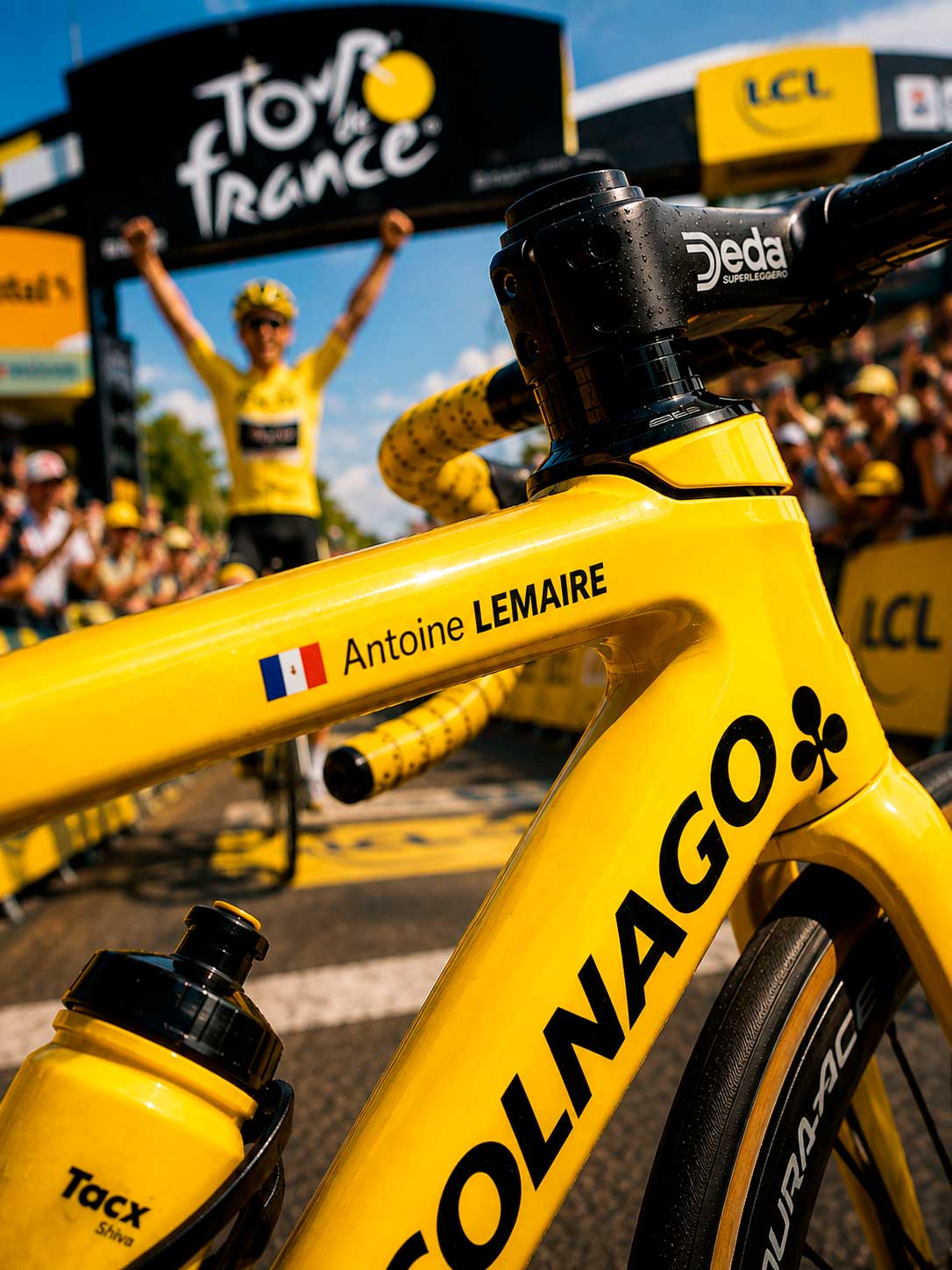
The history of Colnago began in 1954 in a small workshop in Cambiago, near Milan. From those modest beginnings, Ernesto Colnago built one of the most recognisable and prestigious bicycle brands in the world.
Colnago’s story connects traditional Italian frame building with professional racing, technical experimentation and some of cycling’s most famous riders.
Its bicycles have been made from steel, aluminium, titanium and carbon fibre. They have been ridden to victories in Grand Tours, world championships, Monument classics and hour-record attempts.
This is the story of how a 20-square-metre workshop in Cambiago became an international symbol of Italian cycling.
Where is Colnago from?
Colnago is from Cambiago, a town in Lombardy, approximately 25 kilometres north-east of Milan.
The company’s identity remains closely connected with the town. Cambiago is not simply the location where the business began: it forms part of Colnago’s design language, manufacturing tradition and brand mythology.
The letter C in famous model names such as C40, C59 and C68 has been associated with Colnago, Cambiago and carbon.
Colnago’s premium C-Series frames continue the company’s modular construction tradition. Tubes and joints are shaped, finished, bonded and assembled through a specialised process in Italy.
Make your bike easier to identify and give it a clean professional look.
Who founded Colnago?
Colnago was founded by Ernesto Colnago in 1954.
Before creating his own company, Ernesto worked for the Gloria bicycle factory in Milan. He was also interested in racing, but an accident during cycling training forced him to work from home.
There, he began making wheels by assembling rims, hubs and sprockets. The work convinced him that he could build an independent business around his mechanical ability.
His father helped him create a workbench using wood from a mulberry tree in the family garden.
Ernesto opened his first workshop at Via Garibaldi 10 in Cambiago. The premises measured only around 20 square metres, but they became the starting point for an extraordinary career as a mechanic, frame builder and entrepreneur.
Ernesto Colnago and the 1955 Giro d’Italia
One of the first important moments in Colnago’s history came through Italian champion Fiorenzo Magni.
According to Colnago’s official history, Ernesto met Magni during a training ride. The cyclist was experiencing pain, and Ernesto identified incorrectly installed cranks as the source of the problem.
After Ernesto corrected the issue, Magni invited him to work alongside him at the 1955 Giro d’Italia.
Magni won the race, giving the young mechanic valuable experience and visibility inside professional cycling.
The relationship between frame builders, mechanics and professional riders would become central to Colnago’s development.
Ernesto did not design bicycles in isolation. He listened to riders, observed racing conditions and used professional competition as a testing ground for new ideas.
Early innovation in steel bicycle frames
Colnago developed a reputation for innovation during the era of steel frames.
In 1956, Ernesto introduced a new method for cold-bending fork blades. Traditional production frequently involved heating the tubes before shaping them. Ernesto found a way to create the required curve without applying heat.
This helped produce forks intended to be both resilient and responsive.
Professional riders began visiting the Cambiago workshop for customised frames and mechanical work. Some of these bicycles were painted and branded for other sponsors, meaning Colnago’s craftsmanship was present in the professional peloton before the name was always visible.
That combination of technical skill and close contact with elite cyclists helped transform the workshop into a recognised frame manufacturer.
Colnago and Eddy Merckx
Eddy Merckx played an important role in making Colnago famous internationally.
Ernesto Colnago worked with Merckx and the Molteni team during one of the most successful periods in professional cycling history.
The relationship began after Merckx needed carefully prepared wheels for Milan–San Remo. The work met the rider’s requirements, and the partnership developed further.
Colnago subsequently built numerous bicycles for Merckx.
One of the most famous was the steel bicycle used for Merckx’s hour record in 1972. Colnago states that the bike weighed approximately 5.75 kilograms, an exceptional figure for a steel machine from that period.
Merckx’s success gave Colnago an international stage. The association connected the craftsmanship of Cambiago with the achievements of one of cycling’s greatest riders.
The Colnago Super
Introduced in the late 1960s, the Colnago Super became one of the company’s defining steel racing bicycles.
It was created during a period when race frames were evolving towards lighter, stiffer and more responsive designs.
The Super helped establish proportions and construction principles that influenced racing bicycles well beyond the Colnago brand.
Its combination of elegant steel tubes, racing geometry and detailed finishing represented what many cyclists came to expect from a high-level Italian road bike.
Today, original examples are sought after by collectors and enthusiasts of classic cycling.
The Colnago Mexico
The Colnago Mexico appeared during the 1970s and was closely connected with the achievements of Eddy Merckx.
Its name referenced Merckx’s 1972 hour record in Mexico City.
Different versions were produced over time, including the Mexico Oro and Mexico TT. These bicycles reflected Colnago’s willingness to combine racing heritage with distinctive finishes and experimental construction.
The Mexico name remains one of the most recognisable parts of the company’s steel-frame history.
The Colnago Master
The Colnago Master was introduced in 1983 and became one of the most celebrated steel racing frames ever produced.
Its most recognisable feature is its star-shaped tube profile, often associated with Gilco tubing.
Rather than using conventional round tubes throughout the frame, the Master’s shaped tubes were intended to improve stiffness while giving the bicycle a distinctive appearance.
The Master also became known for elaborate paintwork, chrome details and Colnago’s club-shaped logo.
Although bicycle technology has moved towards carbon fibre and electronic components, the Master remains closely associated with traditional Italian frame building.
Its appeal is not based only on nostalgia. It represents a period in which performance engineering, craftsmanship and visual identity were expressed through steel.
The Precisa straight fork
Colnago introduced the Precisa straight-blade fork during the late 1980s.
At the time, most road-bike forks used visibly curved blades. The Precisa’s straight design gave Colnago bicycles a distinctive profile and challenged established expectations about how a racing fork should look.
The design became one of the company’s signatures.
Versions of the Precisa were produced in steel and later in carbon fibre. The fork appeared on several important Colnago models and helped create a visual link between the company’s steel and carbon generations.
Colnago and Ferrari
Ernesto Colnago developed a relationship with Enzo Ferrari during the 1980s.
The two brands shared an interest in performance, engineering, advanced materials and Italian design.
Their collaboration helped Colnago explore carbon fibre at a time when the material was still unusual in bicycle frames.
The projects created through the Colnago–Ferrari relationship were not simply exercises in attaching two prestigious names to the same product. They contributed to the company’s experimentation with materials and construction techniques that would influence later bicycles.
This period helped prepare the way for one of the most significant models in Colnago’s history: the C40.
The Colnago C40 and the carbon revolution
The Colnago C40 was introduced in 1994.
Its name referenced Colnago, Cambiago, carbon and approximately 40 years of the company’s experience.
The C40 used carbon tubes connected by carbon lugs. This construction followed the logic of traditional lugged steel frames while applying it to a new material.
At a time when some riders and mechanics questioned whether carbon could survive the demands of professional racing, the C40 provided a powerful answer.
The bicycle achieved famous victories on the cobbles of Paris–Roubaix, one of the toughest races for any frame.
Franco Ballerini won Paris–Roubaix on a C40 in 1995. Further victories followed, helping establish carbon fibre as a credible material for top-level road racing.
The C40’s importance extends beyond Colnago. It helped demonstrate that a carbon bicycle could combine low weight, stiffness, durability and success in the most demanding conditions.
Colnago in professional cycling
Professional racing has always been central to Colnago’s identity.
The brand has worked with riders and teams across road cycling, track competition, cyclocross and time trials.
Colnago bicycles have been associated with riders including:
- Fiorenzo Magni
- Eddy Merckx
- Gianni Motta
- Giuseppe Saronni
- Tony Rominger
- Franco Ballerini
- Oscar Freire
- Wout van Aert
- Tadej Pogačar
During the 1990s and early 2000s, Colnago bicycles achieved victories in Grand Tours, Monument classics and world championships.
In 1998, the three leading teams in the UCI classification—Mapei, Rabobank and Casino–Ag2r—were all using Colnago bicycles.
The company’s racing history has done more than provide marketing images. Feedback from professional riders and mechanics helped drive changes in geometry, materials, forks and construction.
From steel to carbon fibre
Colnago’s history can be understood through its use of different frame materials.
Steel
Steel established Colnago’s reputation. Models such as the Super, Mexico and Master demonstrated the company’s approach to racing geometry, tube shaping and craftsmanship.
Aluminium
Colnago also experimented with aluminium as manufacturers searched for lower weight and increased stiffness.
Titanium
Titanium appeared in specialised Colnago projects and models. It offered corrosion resistance and a distinctive ride quality, although it never became as central to the company as steel or carbon.
Carbon fibre
Carbon ultimately became the principal material for Colnago’s highest-performance bicycles.
The C40 began a lineage that continued through models such as the C50, C59, C60, C64 and C68.
The company retained modular tube-and-lug construction for its premium C-Series even as many manufacturers adopted monocoque production.
This allowed Colnago to connect modern carbon technology with the methods and visual proportions of traditional frame building.
The Colnago C-Series
The C-Series represents the strongest link between Colnago’s heritage and its modern bicycles.
Important models include:
- C40
- C50
- C59
- C60
- C64
- C68
These names do not simply indicate a conventional product sequence. They relate to significant periods in Colnago’s history, beginning with the company’s foundation in 1954.
The series is characterised by modular carbon construction, detailed finishing and a close association with Cambiago.
Cyclists interested in one of the important generations can also read our review of the Colnago V3Rs, a more competition-focused carbon platform from a later period in the brand’s history.
Why does Colnago use a club logo?
Colnago’s logo is based on the ace of clubs.
The emblem is one of the most recognisable symbols in cycling. Its shape is often combined with rainbow colours, references to racing victories and detailed paint schemes.
The club helps distinguish a Colnago even when the complete brand name is not visible.
Over time, it has appeared on head badges, frame tubes, forks, components, team clothing and accessories.
Together with the traditional celeste colour associated with Italian cycling, the ace of clubs has become part of Colnago’s international visual identity.
Are Colnago bicycles made in Italy?
The answer depends on the model.
Colnago’s premium C-Series continues to emphasise Italian craftsmanship. The company states that these frames are built, painted and assembled in Italy through a modular process involving separately shaped tubes and joints.
Other Colnago models may use different production systems and locations.
Buyers who want to know where a specific bicycle was manufactured should check the exact model, frame markings and current information provided by Colnago or an authorised dealer.
It is inaccurate to assume that every bicycle carrying an Italian brand name is manufactured entirely in the same place.
Is Colnago a good bicycle brand?
Colnago is one of the most historically important brands in performance cycling.
Its reputation is based on:
- More than seven decades of frame-building experience
- Close relationships with professional riders
- Important racing victories
- Innovation in steel and carbon construction
- Distinctive Italian design
- A strong premium-bike identity
That does not mean every Colnago is automatically the correct bicycle for every rider.
Fit, geometry, intended use, component specification, maintenance and budget remain more important than the name on the frame.
A correctly fitted bicycle from a less prestigious brand will usually serve a rider better than an unsuitable Colnago purchased only for its history.
Buying a used Colnago
Colnago’s reputation makes its bicycles desirable on the second-hand market. It also means buyers should inspect them carefully.
Before buying, check:
- The frame’s serial number and identifying details
- Frame and fork condition
- Evidence of crashes or repairs
- Correct size and geometry
- Bottom-bracket and headset standards
- Seatpost condition
- Wheel and brake compatibility
- Availability of proprietary components
- Whether the paint and decals are original
- Documentation supplied by the seller
Classic steel models require a different inspection from modern carbon bicycles.
With a carbon frame, pay particular attention to impact marks, cracks, compression damage and repairs. If anything is uncertain, ask a carbon-frame specialist or experienced bicycle workshop to inspect it.
Personalising a Colnago bicycle
Colnago bicycles are known for detailed paintwork and a strong visual identity. Any personalisation should complement the original design rather than overwhelm it.
A small name and national flag sticker can give the bicycle a professional appearance while preserving the lines of the frame.
Professional cyclists have long used name and flag decals to identify their bicycles. Our guide explains why professional cyclists put their name and flag on the top tube.
For modern carbon models, read our advice on whether stickers can damage a carbon bicycle frame before installation.
Pegatin creates custom name and flag stickers for bicycle frames in sizes and colour combinations suitable for road bikes.
To obtain a clean result, follow the correct process for applying and removing custom bicycle stickers.
Frequently asked questions about Colnago
Where is Colnago from?
Colnago is from Cambiago, a town in Lombardy near Milan, Italy. Ernesto Colnago opened his first workshop there in 1954.
Who founded Colnago?
Ernesto Colnago founded the company. He began as a mechanic and wheel builder before becoming one of cycling’s most famous frame builders.
When was Colnago founded?
Colnago was founded in 1954.
What does Cambiago mean to Colnago?
Cambiago is the town where the company began and remains an essential part of its identity. It is associated with Colnago’s workshop, craftsmanship and premium C-Series production.
What does the C stand for in Colnago C40 and C68?
Colnago associates the letter with Colnago, Cambiago and carbon. The model numbers also relate to milestones in the company’s history.
What is the most famous Colnago bicycle?
The C40 is one of the most historically significant Colnago bicycles because it helped establish carbon fibre in professional road racing. The steel Master is also one of the company’s most recognisable models.
Did Eddy Merckx ride Colnago bicycles?
Yes. Ernesto Colnago worked closely with Eddy Merckx and built bicycles for him, including the lightweight steel machine used for his 1972 hour record.
Are Colnago bikes made in Italy?
Some are. Colnago states that its premium C-Series frames are built, painted and assembled in Italy. Production arrangements can differ for other models.
Why is the Colnago C40 important?
The C40 demonstrated that carbon-fibre frames could succeed under the severe conditions of professional road racing, including Paris–Roubaix.
Is Colnago still involved in professional cycling?
Yes. Colnago continues to supply bicycles at the highest level of professional road racing.
Add the Finishing Touch to Your Bike
Colnago has always stood for identity, heritage and attention to detail. One simple way to give your own bike that same personal touch is to add your name and national flag to the frame. It’s a subtle detail inspired by professional race bikes and works without changing the original look of the bike.
Conclusion
Colnago’s history began with Ernesto Colnago, a small workshop and a wooden workbench in Cambiago in 1954.
From there, the company progressed through steel masterpieces such as the Super, Mexico and Master, technical experiments with Ferrari and the carbon-fibre revolution represented by the C40.
Its relationship with riders such as Fiorenzo Magni, Eddy Merckx and generations of professional champions turned the Colnago name into an international symbol of racing heritage.
Despite its global recognition, Cambiago remains at the heart of the story.
Colnago’s greatest achievement may be its ability to evolve without completely abandoning its origins. Its modern bicycles combine carbon engineering and professional competition with the identity of a traditional Italian frame builder.
That connection between craftsmanship, innovation and racing history is why the ace of clubs remains one of the most respected symbols in cycling.
Add your own identity to a cycling icon
Every Colnago carries decades of cycling history. A personalised name and national flag sticker lets you add your own identity without taking attention away from the bicycle’s original design.
Pegatin creates lightweight custom stickers for road, gravel, mountain and triathlon bikes, with colours and sizes that can be adapted to your frame.
Create your personalised bicycle stickers
Give your bike a personalised finishing touch — use code PRODECALS for 15% off