Personalise your bike for your next event — use code EVENT15 for 15% off
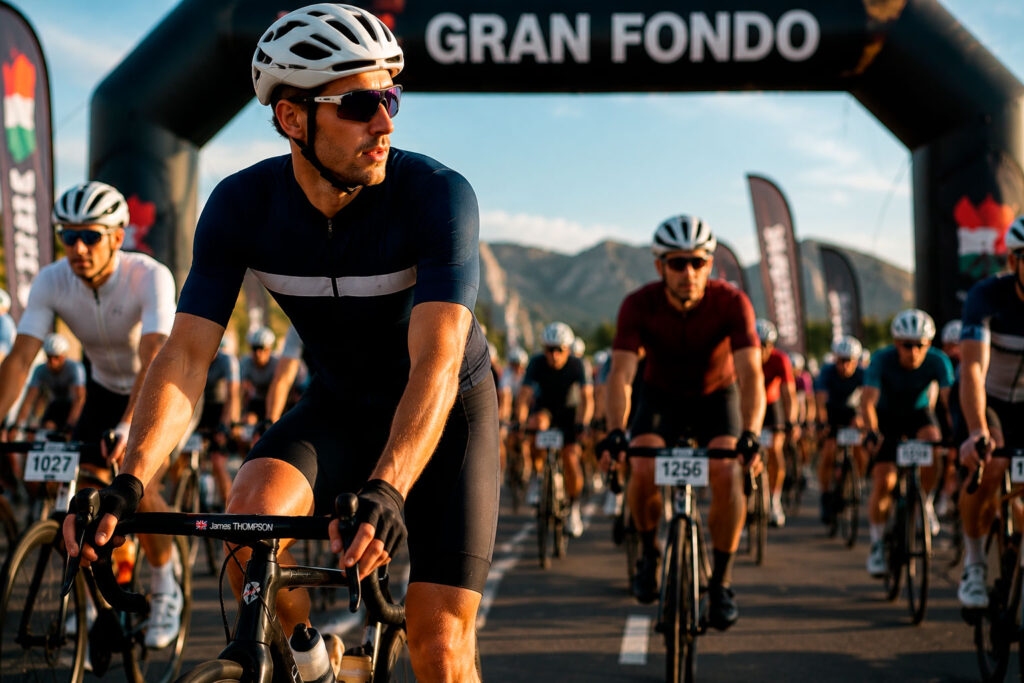
You’ve entered your first Gran Fondo.
Now what?
For many amateur cyclists, entering a Gran Fondo is the moment cycling changes from simply going for rides to preparing for a real cycling challenge.
You’ve chosen a date and distance, and you’ve probably started thinking about training.
And as the event gets closer, the questions begin.
What should I bring?
How fast should I start?
What should I eat?
What happens if I puncture?
How early should I arrive?
And perhaps the biggest question:
Am I actually ready for this?
Don’t worry.
Therefore, your first Gran Fondo doesn’t need to be perfect.
Instead, it needs to be an experience you’ll want to repeat.
Here’s everything you need to know.
What Is a Gran Fondo?
Gran Fondo literally means “big ride” in Italian.
Today, however, the term is used internationally for organised mass-participation cycling events, typically covering substantial distances on roads with timing, feed stations, mechanical assistance and event infrastructure.
Depending on the event, you’ll ride alongside everyone from recreational cyclists attempting their first major challenge to extremely strong amateur racers.
That’s part of what makes Gran Fondos special.
You don’t need to be a professional cyclist.
However, for one day, you get to experience some of the atmosphere surrounding competitive cycling.
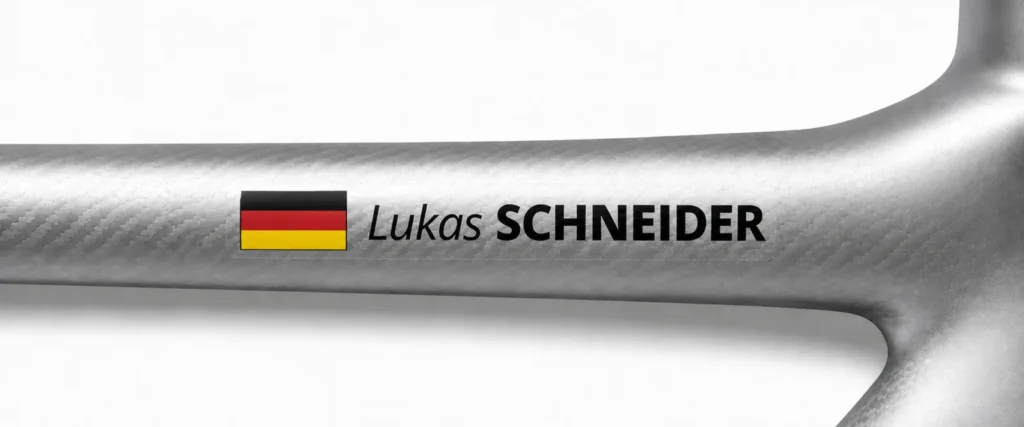
Make your bike easier to identify and give it a clean professional look.
Is a Gran Fondo a Race?
In practice, sometimes yes.
Sometimes no.
In fact, sometimes it’s somewhere in between.
For example, many Gran Fondos are timed and publish finishing results, while others emphasise completing the course rather than outright competition.
At the front, for example, riders may be racing extremely seriously.
Meanwhile, further back, thousands of cyclists may simply be trying to finish.
Ultimately, your objective is yours.
It might be:
Finish the event.
Beat a target time.
Stay with your friends.
Finish inside the top 20%.
Or simply:
Enjoy one of the biggest cycling days of your life.
For your first Gran Fondo, finishing comfortably is already a great objective.
One Small Detail. A Completely Different Look.
Give your road bike the personalised finishing touch inspired by professional cycling.
10 personalised Pegatins · Black + white options · Worldwide shipping included
How Fit Do You Need to Be?
However, that depends enormously on the event.
A 90 km rolling Gran Fondo is very different from:
160 km + 3,000 metres of climbing.
Before entering, look carefully at:
- total distance;
- elevation gain;
- longest climb;
- maximum gradient;
- expected weather;
- cut-off times.
Don’t judge an event purely by kilometres.
Elevation changes everything.
How Far Should You Ride Before Your First Gran Fondo?
You don’t necessarily need to complete the entire event distance in training.
Nevertheless, you should be comfortable spending several hours on the bike.
In addition, your long rides should progressively teach your body to deal with:
- fatigue;
- nutrition;
- hydration;
- saddle comfort;
- pacing;
- climbing;
- changing weather.
Your longest training rides are also where you should test the equipment and nutrition you’ll use on event day.
Above all, nothing important should be completely new on race morning.
Don’t Turn the First 20 km Into a Race
In fact, this is one of the easiest mistakes to make.
At first, the atmosphere is exciting.
Everyone is overtaking.
Groups are forming.
Your legs feel fantastic.
And suddenly you’re riding considerably harder than planned.
Remember:
everyone feels strong during the first hour.
Ultimately, the important question is how you’ll feel during the final hour.
Therefore, start conservatively.
Let riders go.
Find your rhythm.
Afterwards, there will be plenty of time to ride harder later.
Riding in a Group Can Save Energy
In addition, one major difference between training alone and riding a Gran Fondo is the number of cyclists around you.
For example, drafting behind other riders can substantially reduce the effort required to maintain speed.
Ideally, try to find a group riding at a pace you can sustain.
But don’t join a group that’s clearly above your level just because it’s fast.
And if you’re inexperienced riding in groups, practise before the event.
Ride predictably.
Likewise, avoid sudden braking.
Point out hazards.
Don’t overlap wheels unnecessarily.
Finally, communication matters.
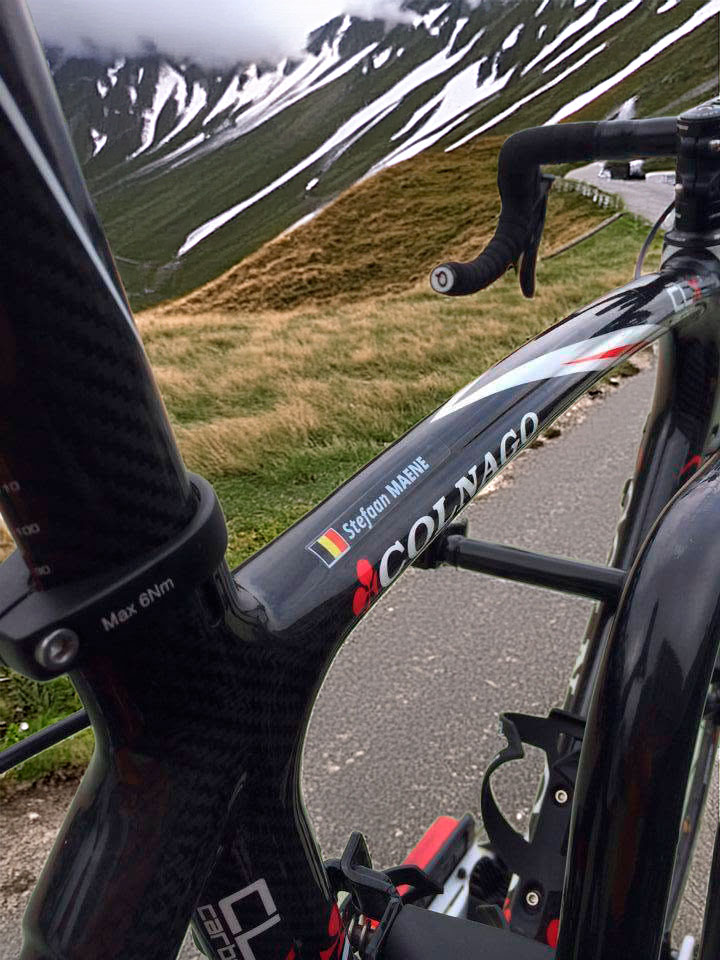
Ready for Your Next Big Ride?
Prepare your bike, prepare yourself — and add the finishing touch seen on professional race bikes: your name + your national flag.
CREATE YOUR PERSONALISED PEGATIN →
Prepare Your Bike Before the Event
However, your fitness means very little if your bike doesn’t finish.
Therefore, several days before your Gran Fondo, check:
Tyres
✓ condition
✓ cuts
✓ pressure
✓ sealant if tubeless
Brakes
✓ pad wear
✓ braking performance
✓ rotors or braking surfaces
Drivetrain
✓ chain
✓ cassette
✓ shifting
✓ lubrication
Wheels
✓ bearings
✓ spokes
✓ tyres
Contact points
✓ saddle
✓ handlebars
✓ pedals
✓ cleats
We’ve created a complete guide specifically for this:
How to Prepare Your Road Bike for a Sportive or Gran Fondo
Therefore, do the work several days before the event — not at 11pm the night before.
What Should You Carry During a Gran Fondo?
However, the exact requirements depend on the event, so always check the organiser’s rider guide.
Nevertheless, your basic repair kit should normally allow you to solve common roadside problems.
Consider carrying:
- spare inner tube or tubeless repair kit;
- tyre levers;
- mini pump or CO₂ inflator;
- multitool;
- chain quick-link;
- phone;
- identification;
- emergency cash or payment card.
Official Gran Fondo packing checklists commonly include a spare tube, multitool, tyre levers, pump/CO₂ and nutrition among the essentials. Shimano Road
And one important detail:
know how to use your tools.
Of course, carrying a spare tube is pointless if you’ve never changed one.
What Should You Eat During a Gran Fondo?
Most importantly, your Gran Fondo is not the day to experiment with nutrition.
Instead, use foods and products you’ve already tested during long training rides.
Depending on the event, you might use:
- gels;
- energy bars;
- bananas;
- sandwiches;
- carbohydrate drink;
- other easily digestible foods.
Most importantly, the important thing is to start eating before you’re hungry.
Once you’re badly depleted, recovering while continuing to ride can be difficult.
Similarly, drink regularly rather than waiting until you’re extremely thirsty.
Your individual requirements vary with body size, intensity, temperature, duration and other factors, so your event nutrition strategy should be developed during training.
Don’t Rely Completely on Feed Stations
Although feed stations are fantastic.
But don’t make them your entire nutrition strategy.
You don’t know:
- exactly what products they’ll have;
- whether those products suit your stomach;
- how crowded the station will be;
- whether something will run out.
Therefore, carry enough familiar nutrition to protect your ride.
Then use feed stations to supplement it.
Check the Weather — Then Check It Again
A Gran Fondo can start cold, become hot and finish in rain.
In particular, mountain events are particularly unpredictable.
Depending on conditions, consider:
- gilet;
- arm warmers;
- rain jacket;
- gloves;
- sunscreen.
For example, compact layers can make an enormous difference when descending after a long climb.
Prepare Everything the Night Before
Do not rely on your brain at 5:30am.
Lay everything out.
Cycling kit
✓ jersey
✓ bib shorts
✓ socks
✓ shoes
✓ helmet
✓ sunglasses
✓ gloves
Bike equipment
✓ bottles
✓ repair kit
✓ computer
✓ lights if required
✓ event number
Nutrition
✓ gels
✓ bars/food
✓ drink mix
✓ breakfast
Electronics
✓ bike computer charged
✓ phone charged
✓ electronic gears charged
✓ lights charged
Shimano’s Gran Fondo checklist specifically includes GPS devices, smartphone/GPS charging cables and Di2 charging alongside the riding equipment. Shimano Road
Download the Route Before You Leave
Even if the route is signposted, put it on your cycling computer.
Check:
- total distance;
- elevation;
- major climbs;
- feed stations;
- technical descents;
- cut-off points.
Knowing what’s coming makes pacing much easier.
A 5 km climb feels very different when you know it’s 5 km rather than wondering whether it lasts another 15.
Arrive Early
Your first Gran Fondo morning will take longer than expected.
Parking.
Registration.
Toilets.
Bike preparation.
Finding your start area.
Meeting friends.
Another toilet visit.
Give yourself time.
The objective is to arrive at the start line thinking:
I’m ready.
Not:
WHERE IS MY START PEN?!
Make Your Bike Easy to Recognise
Now comes one of the details many first-time riders don’t think about.
There can be hundreds or thousands of bicycles at a major Gran Fondo.
And modern premium road bikes often look surprisingly similar.
Black carbon frames.
The same manufacturers.
Similar wheels.
Similar helmets.
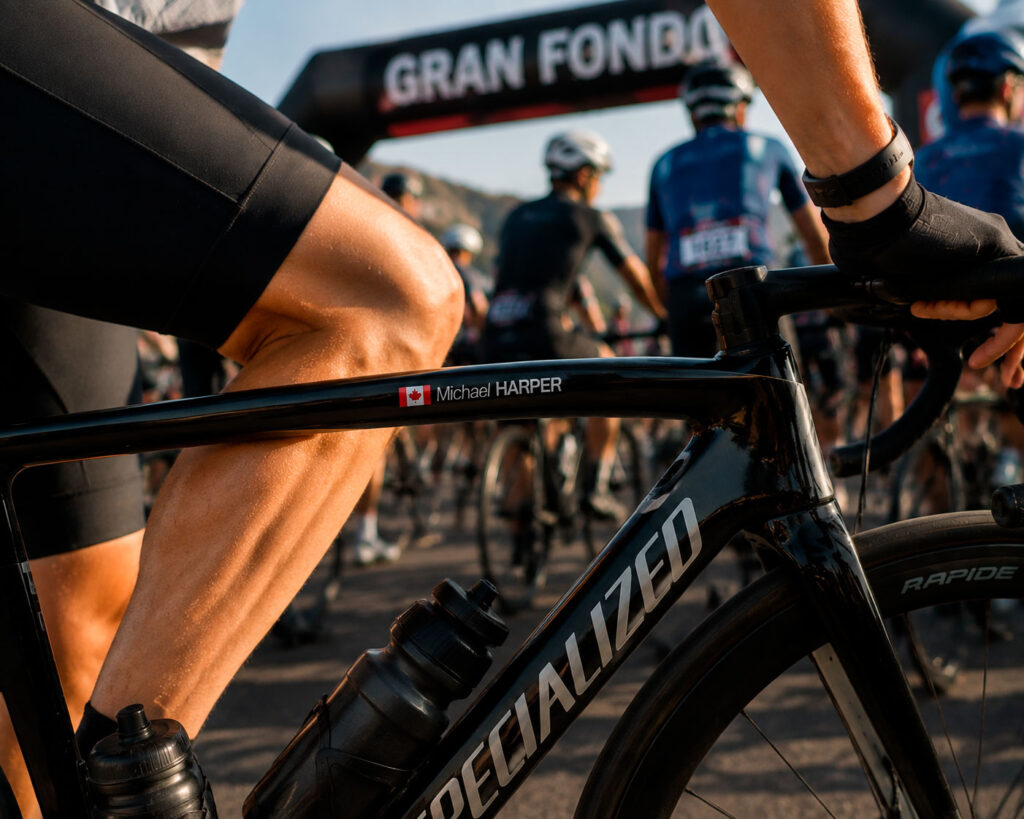
Personalising your bike with your national flag + name makes it instantly recognisable.
It’s also one of those small details that makes your first major cycling event feel special.
Professional cyclists have used name-and-flag identification on their equipment for years.
We’ve explained why here:
Why Pro Cyclists Put Their Name and Flag on the Top Tube
Give Your Bike the PRO Look
After months of training and equipment preparation, you may also have spent more on your bike than you’d like to admit.
Now add the finishing detail.
Your country, name and bike complete the final detail.
Create your personalised Pegatin →
Which Pegatin Should You Choose for a Gran Fondo?
This depends primarily on your bike and equipment.
Pegatin offers different options depending on how and where you want to use them.
We’ve created a complete comparison here:
Pegatin BASIC vs PRO vs PLUS: Which Pack Should You Choose?
Having both light and dark lettering options is particularly useful when you want to personalise different surfaces.
For example:
dark bike → white lettering
white helmet → black lettering
The adhesive itself remains transparent, so the original surface remains visible around the flag and lettering.
Can You Put a Pegatin on a Carbon Frame?
Carbon bikes dominate many Gran Fondo start lines.
Understandably, riders don’t want to damage an expensive frame.
We’ve covered this question separately:
Do Stickers Damage Your Carbon Frame? What Every Cyclist Should Know
And when you’re ready to install yours:
How to Correctly Apply or Remove Custom Bicycle Stickers
Don’t Change Your Bike Position Before the Event
New saddle?
Different stem?
New cleats?
Changed saddle height?
The week before your Gran Fondo is generally not the moment.
Your body has adapted to your existing position.
Even a seemingly small change can become uncomfortable after several hours.
However, if your current setup works:
leave it alone.
What Should You Do if You Get a Puncture?
First:
Don’t panic.
Move safely away from other cyclists.
Find a safe place to stop.
Then repair the puncture using the equipment you’ve practised with.
If you’re tubeless, this may mean using a plug.
If necessary, install an inner tube.
Some events provide mechanical assistance, but don’t assume somebody will immediately appear.
Self-sufficiency is part of long-distance cycling.
What Happens if You Get Dropped?
Nothing.
You keep riding.
Your first Gran Fondo isn’t the Tour de France.
Groups will form and break apart throughout the event.
If the group you’re riding with becomes too difficult:
let them go.
Recover.
Eat.
Drink.
Another group will probably arrive.
Destroying yourself to hold a wheel for another five minutes rarely improves the remaining three hours of your ride.
Save Something for the Final Third
Think of your Gran Fondo in thirds.
First third
Control yourself.
Middle third
Ride efficiently.
Final third
Use what’s left.
If you’re still feeling strong during the final section, start increasing your effort.
Passing riders during the final 30 km is considerably more enjoyable than being passed by everyone because you raced the first 30 km.
Your First Gran Fondo Race-Day Checklist
Before leaving:
✓ Bike
✓ Helmet
✓ Shoes
✓ Sunglasses
✓ Cycling kit
✓ Bottles
✓ Nutrition
✓ Repair kit
✓ Phone
✓ Wallet/ID
✓ Event registration information
✓ Bike computer
✓ Route downloaded
✓ Appropriate weather clothing
Before starting:
✓ Tyre pressure
✓ Bottles full
✓ Computer on
✓ Route loaded
✓ Nutrition accessible
✓ Helmet secured
✓ Event number attached
✓ Phone stored safely
Then stop worrying.
You’re ready.
First Gran Fondo FAQ
How long is a Gran Fondo?
There is no universal distance. Gran Fondos vary considerably, although many are long-distance cycling events with substantial climbing. Always check the specific event profile rather than judging difficulty by distance alone.
Do I need a racing licence?
It depends on the event and country. Check the organiser’s entry requirements before registering.
Do I need an expensive road bike?
No. A reliable, correctly maintained bike suitable for the route is more important than owning the most expensive equipment.
Should I use a saddle bag?
If it comfortably carries your repair equipment, absolutely. There’s little benefit in filling every jersey pocket unnecessarily.
Should I use tubeless tyres?
Both tubeless and inner-tube systems can work. Use the system you’re comfortable maintaining and repairing.
Can I ride a Gran Fondo alone?
Yes. Many riders enter alone and naturally find groups of similar ability during the event.
Should I put my name on my bike?
It’s optional, but personalised rider identification makes your bike easier to recognise and recreates a detail commonly seen on professional racing equipment.
Where should I put my name sticker?
The top tube is the classic position. You can also personalise compatible equipment such as your helmet.
Read our guide to name and flag stickers for cycling helmets.
Final Thoughts
Your first Gran Fondo isn’t really about your finishing position.
It’s about everything that got you there.
Think of the early mornings, long rides, unwanted climbs, bad-weather training, punctures and tired legs.
And finally:
the start line.
Prepare properly.
Start conservatively.
Eat before you’re hungry.
Drink before you’re thirsty.
Ride your own event.
And enjoy it.
Because you’ll only ride your first Gran Fondo once.
Make the bike underneath you unmistakably yours.
Ready to choose your next challenge? Explore our 2027 cycling events calendar to discover some of the best gran fondos, sportives and endurance cycling events around the world.
Your bike, your name and your flag.
CREATE YOUR PERSONALISED PEGATIN →
Personalise your bike for your next event — use code EVENT15 for 15% off
Order ahead of your event: personalised production and shipping take time. Do not leave your order until the last few days.