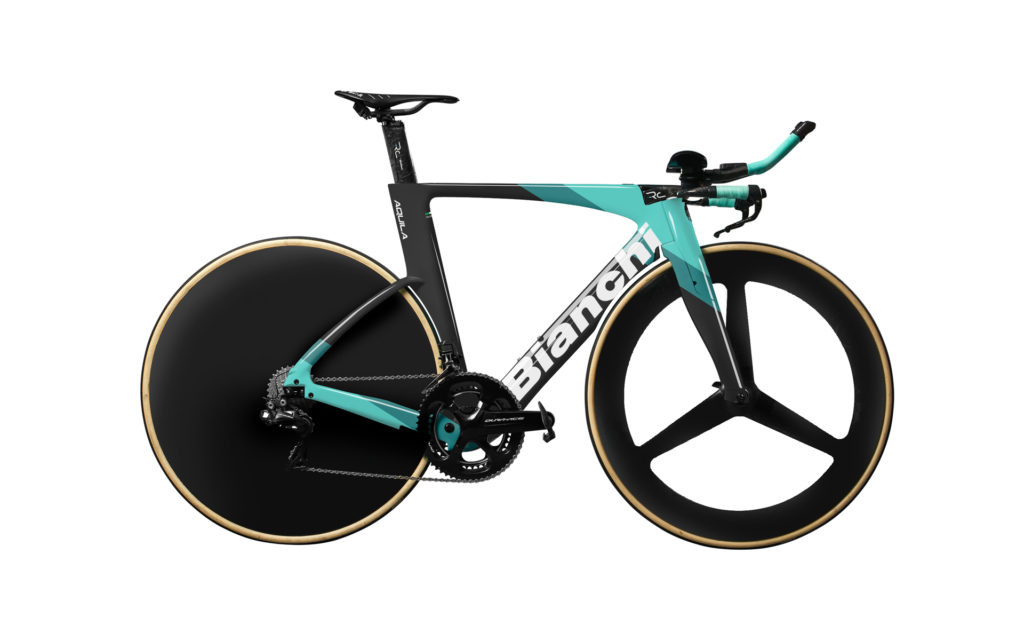
The Bianchi Aquila CV is a carbon time-trial and triathlon bike created for riders who prioritise aerodynamics, speed and an aggressive racing position.
It combines a highly sculpted carbon frame, integrated components and Bianchi’s Countervail technology in a bicycle designed to reduce aerodynamic drag during individual efforts against the clock.
The Aquila CV belongs to an earlier generation of Bianchi’s competition time-trial range. It is no longer the brand’s latest model, but it remains interesting to triathletes, time-trial specialists and buyers looking for a distinctive aerodynamic bike on the second-hand market.
In this review, we examine the Bianchi Aquila CV frame, its principal features, typical specifications, riding position and how it compares with Bianchi’s current Aquila RC.
Personalise your triathlon bike — use code PRODECALS for 15% off
What is the Bianchi Aquila CV?
The Bianchi Aquila CV is a specialist carbon bicycle developed for time trials and triathlons.
Unlike a conventional road bike, it uses a frame, cockpit and riding position designed to reduce the frontal area presented to the wind. Its geometry places the rider in a lower and more forward position that can improve aerodynamic efficiency when properly fitted.
The letters “CV” refer to Countervail, the vibration-cancelling carbon technology used by Bianchi in several of its high-performance bicycles.
The original Aquila CV was introduced during the rim-brake era. Different complete-bike configurations were offered over the years, while the frameset could also be used for custom builds.
Because specifications changed between markets and model years, buyers should check the exact components fitted to an individual bicycle rather than relying only on the model name.
Make your bike easier to identify and give it a clean professional look.
Is the Bianchi Aquila CV still available?
The Aquila CV belongs to Bianchi’s previous generation of time-trial bicycles.
Bianchi currently promotes the Aquila RC as its principal competition-focused time-trial platform. The older Aquila CV can still appear in catalogue archives, dealer stock and the second-hand market.
This does not automatically make the Aquila CV obsolete or unsuitable.
A well-maintained example can still be an effective time-trial or triathlon bike. However, its rim brakes, tyre-clearance limitations, integrated parts and older component standards should be considered carefully before purchase.
Replacement-part availability is particularly important with specialist aerodynamic bicycles because components such as cockpit pieces, covers, seatposts and brake hardware may be specific to the frame.
Bianchi Aquila CV frame and Countervail technology
The central feature of the Aquila CV is its aerodynamic carbon frameset.
Bianchi incorporated Countervail material into the carbon structure. According to the company, Countervail was developed to reduce vibration while maintaining the stiffness required for performance.
On a time-trial bicycle, reducing vibration can be valuable because the rider spends long periods supporting the upper body on the aero extensions.
A more controlled ride may make it easier to maintain the intended aerodynamic position, particularly on rough roads. Nevertheless, comfort also depends on tyre choice, pressure, saddle, cockpit adjustment and professional bike fitting.
The frame uses aero-profiled tube shapes and extensive integration to help manage airflow around the bicycle and rider.
Its appearance is unmistakably that of a dedicated time-trial machine rather than a conventional road bike with clip-on aero bars.
Aerodynamic design
Aerodynamics are the Aquila CV’s main purpose.
Its design includes:
- Deep aerodynamic tube profiles
- A narrow frontal area
- An integrated time-trial cockpit
- A frame-specific aerodynamic seatpost
- Concealed or closely integrated brake components
- Internal cable routing
- A rear-wheel cut-out
- A low, forward-facing race position
Each feature attempts to reduce drag or improve the interaction between the frame, wheels and rider.
The rider remains the largest source of aerodynamic resistance. For that reason, the bicycle’s potential depends heavily on whether the cyclist can maintain a powerful and sustainable position.
A more aggressive setup is not automatically faster if it restricts breathing, reduces power or becomes uncomfortable after a short distance.
Professional fitting is one of the most valuable investments for any dedicated time-trial bike.
Typical Bianchi Aquila CV specifications
The Aquila CV was sold across different years and markets, so no single component list represents every example.
One historical complete build used an 11-speed Shimano Ultegra mechanical drivetrain with Dura-Ace bar-end shifters. Bianchi also offered the Aquila CV as a frameset compatible with mechanical and electronic shifting.
Typical characteristics included:
| Component | Typical Aquila CV specification |
|---|---|
| Frame | Bianchi Aquila CV carbon |
| Technology | Bianchi Countervail |
| Use | Time trial and triathlon |
| Frame sizes | Commonly XS, SM, MD and LG |
| Shifting | Mechanical or electronic compatible, depending on setup |
| Bottom bracket | PressFit 86.5 × 41 mm |
| Brakes | Integrated rim-brake system |
| Handlebar | Integrated carbon aero cockpit |
| Seatpost | Bianchi aerodynamic carbon seatpost |
| Wheels | Dependent on model year or custom build |
| Tyres | Dependent on wheel and model-year specification |
A historical Ultegra build included a 52/36-tooth crankset and an 11-speed cassette. However, many used Aquila CV bicycles have subsequently been upgraded or rebuilt.
Always inspect the actual bicycle and record the model numbers of its drivetrain, brakes, wheels and cockpit.
Integrated cockpit and adjustability
The Aquila CV uses an integrated aerodynamic cockpit with base-bar controls and aero extensions.
Integration can reduce frontal area and create a cleaner appearance, but it can also make adjustment and maintenance more complicated than on a standard road bike.
Before buying a used Aquila CV, check:
- Extension length and angle
- Arm-pad width
- Arm-pad fore-and-aft adjustment
- Stack below the extensions
- Base-bar width
- Condition of the mounting hardware
- Availability of original spacers and bolts
- Cable or wire routing
- Compatibility with the intended shifters
A missing proprietary spacer or mounting component may be difficult to replace.
The cockpit should allow the rider to achieve a sustainable position without exceeding the adjustment limits specified by the manufacturer.
Braking system
The Aquila CV was designed around integrated rim brakes.
Concealing the brakes contributes to its aerodynamic appearance, but integrated systems can be more difficult to access, adjust and service than conventional callipers.
Check that:
- Both brakes move freely
- The pads contact the braking surface correctly
- The return mechanism works properly
- Cables and housing are in good condition
- The brake covers are present
- The wheels and brake pads are compatible
- There is sufficient stopping performance for the intended conditions
Rim braking can still be effective when correctly maintained, but performance may differ from a modern hydraulic disc-brake system, particularly in wet conditions or with certain carbon rims.
Anyone considering deep-section or disc wheels must confirm brake-track and pad compatibility.
Bianchi Aquila CV geometry and riding position
The Aquila CV uses dedicated time-trial geometry.
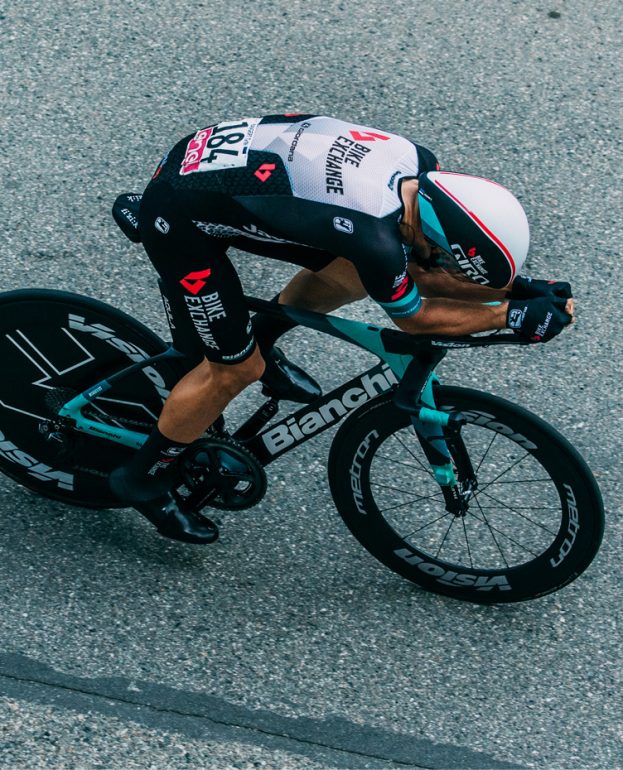
Compared with a normal endurance or race bike, it is intended to support a more aerodynamic posture with the rider’s forearms on the aero extensions.
The effective position depends on several adjustable elements:
- Saddle height
- Saddle fore-and-aft position
- Saddle choice
- Extension reach
- Arm-pad stack
- Arm-pad width
- Cleat position
- Crank length
Frame size alone does not guarantee a correct fit.
Two riders of similar height may require different setups because of differences in leg length, torso length, flexibility, event distance and preferred position.
Before buying a used Aquila CV, compare the available adjustment range with your current fit coordinates or consult an experienced bike fitter.
How does the Bianchi Aquila CV ride?
The Aquila CV is designed to feel stable and efficient at speed when the rider is positioned on the aero extensions.
Its priorities are different from those of a lightweight climbing bike or a conventional road-racing bicycle.
Potential strengths include:
- Aerodynamic efficiency
- High-speed stability
- A stiff platform for sustained power
- A distinctive integrated design
- A position suited to time trials and non-drafting triathlon
Potential disadvantages include:
- Less agility in tight or technical situations
- Reduced comfort when the fit is incorrect
- More complicated maintenance
- Limited versatility
- Older brake and tyre standards
- Dependence on proprietary components
The Aquila CV makes the most sense for riders who regularly train and compete in time trials or triathlons.
It is unlikely to be the best choice as an only bicycle for group rides, climbing routes, commuting or mixed-surface riding.
Bianchi Aquila CV for triathlon
The Aquila CV can be used for triathlon, particularly on courses where aerodynamic efficiency and sustained speed are important.
Before racing, consider how the bicycle will carry:
- Hydration
- Nutrition
- Repair equipment
- A cycling computer
- Race identification
- Any storage required for the event
Accessories should be positioned securely and should not interfere with steering, braking or the rider’s movement.
The most aerodynamic-looking arrangement is not always the most practical. Riders need to reach hydration and nutrition without repeatedly leaving the aero position or losing control.
For longer events, comfort and accessibility become increasingly important.
Bianchi Aquila CV for time trials
The Aquila CV’s dedicated geometry and cockpit make it well suited to individual time trials.
However, race regulations can restrict saddle position, extension length, equipment dimensions or component configuration.
Cyclists entering regulated events should check the current rules of their federation or event organiser.
Triathlon and cycling time-trial regulations are not always identical.
A setup that is permitted in one discipline may require adjustment in another.
Bianchi Aquila CV vs Aquila RC
The Aquila RC represents Bianchi’s newer time-trial platform.
The two bicycles share the Aquila name and the same broad objective, but they belong to different technological generations.
The older Aquila CV reflects the standards of its era:
- Integrated rim brakes
- Narrower tyre expectations
- Earlier cockpit integration
- Older axle and wheel standards
- Mechanical or electronic shifting compatibility depending on setup
The current Aquila RC uses a more modern platform with disc brakes, thru-axles and compatibility with contemporary electronic groupsets and wheels.
For a rider choosing between them, the principal considerations are not only aerodynamics or appearance.
They should also compare:
- Purchase price
- Brake preference
- Wheel compatibility
- Tyre clearance
- Replacement-part availability
- Ease of maintenance
- Electronic drivetrain compatibility
- Required fit coordinates
- Intended years of ownership
A used Aquila CV may cost considerably less, but the Aquila RC provides a more current foundation for a new high-end build.
Is the Bianchi Aquila CV a good second-hand buy?
The Aquila CV can be an attractive second-hand purchase if it fits the rider and is complete, undamaged and correctly priced.
Before buying one, inspect the following areas carefully:
Frame and fork
Look for cracks, impact marks, unusual paint lines, crushing around clamps and repairs that the seller has not documented.
A specialist should examine anything suspicious.
Integrated cockpit
Confirm that the extensions, arm pads, spacers, covers and original hardware are present.
Check for damage around all clamping areas.
Seatpost and saddle clamp
Verify that the aerodynamic seatpost moves correctly and has not been cut too short for your required saddle height.
Inspect the clamp and mounting hardware.
Brakes
Check the operation and condition of both integrated brakes. Make sure replacement pads, cables and hardware can still be obtained.
Drivetrain
Identify the exact groupset and confirm that all gears work correctly.
Do not assume that a used bicycle retains its original specification.
Wheels
Inspect the rims, braking surfaces, hubs and bearings. Confirm that any carbon rim has been used with suitable brake pads.
Proprietary parts
Ask whether the bicycle includes spare spacers, covers, bolts, hangers and other frame-specific items.
These small parts can be important and difficult to replace.
Fit
Confirm that the frame and cockpit can reproduce your required position.
A low price does not compensate for a bicycle that cannot be adjusted correctly.
Can you put stickers on a Bianchi Aquila CV?
Yes, suitable bicycle stickers can be applied to a Bianchi Aquila CV, provided that the surface is clean, undamaged and prepared correctly.
Because the Aquila CV uses a carbon frame with aerodynamic tube shapes, choose thin, high-quality stickers designed for bicycle frames.
Do not place stickers:
- Over cracks or suspicious damage
- Across moving components
- Over frame serial numbers
- Where they can interfere with brakes or cables
- Across service-access covers
- On surfaces contaminated with grease or polish
If you are concerned about the material, read our guide explaining whether stickers can damage a carbon bicycle frame.
For the best result, follow our instructions for applying and removing custom bicycle stickers correctly.
Personalising a time-trial bike
A personalised name and national flag is particularly appropriate on a time-trial or triathlon bike.
Professional cyclists commonly display their name and flag on the top tube so that mechanics, teammates, photographers and spectators can identify the bicycle quickly.
You can learn more about this tradition in our guide to why professional cyclists put their name and flag on the top tube.
Pegatin creates custom name and flag stickers for bicycle frames that can be adapted to the clean, aerodynamic lines of a time-trial bike.
Possible locations on an Aquila CV include:
- The upper surface of the top tube
- The side of the top tube
- An accessible section of the seat tube
- A storage box that does not require frequent removal
- Another smooth area that does not obstruct cables or service access
Keep the design proportionate to the frame. A small, carefully positioned name and flag usually produces a more professional result than a large graphic covering the bicycle’s aerodynamic shapes.
Frequently asked questions about the Bianchi Aquila CV
What type of bike is the Bianchi Aquila CV?
The Bianchi Aquila CV is a carbon time-trial and triathlon bicycle. It uses dedicated aerodynamic geometry and an integrated cockpit.
What does CV mean on a Bianchi bike?
CV refers to Countervail, the vibration-cancelling carbon technology used by Bianchi in several performance bicycles.
Is the Bianchi Aquila CV a road bike?
It is designed for riding on the road, but it is not a conventional drop-handlebar road bike. It is a specialist time-trial and triathlon machine.
Is the Bianchi Aquila CV still made?
The Aquila CV belongs to an earlier generation of Bianchi’s time-trial range. Bianchi’s current platform uses the Aquila RC name.
Does the Bianchi Aquila CV use disc brakes?
The original Aquila CV platform uses integrated rim brakes. The newer Aquila RC uses a modern disc-brake platform.
Can the Aquila CV use electronic shifting?
Bianchi listed the Aquila CV frameset as compatible with mechanical and electronic shifting. Compatibility still depends on the exact frame, components and installation.
Is the Bianchi Aquila CV suitable for beginners?
It can be ridden by a beginner, but its aggressive position, specialist maintenance and limited versatility make it more suitable for someone committed to time trials or triathlon.
A conventional road bike with clip-on aero bars may be a more adaptable first option.
Is a used Bianchi Aquila CV worth buying?
It can be worthwhile if the bicycle is in good condition, fits correctly, includes its proprietary components and is priced appropriately for an older rim-brake platform.
Conclusion
The Bianchi Aquila CV is a distinctive carbon time-trial bicycle created around aerodynamics, integration and an aggressive racing position.
Its Countervail frame, integrated cockpit and specialist geometry made it an important part of Bianchi’s performance range.
It is no longer the brand’s current time-trial platform, but a well-maintained example can still appeal to riders seeking a dedicated race bike at a lower price than a new Aquila RC.
Before buying one, prioritise fit, frame condition, brake performance and the availability of proprietary parts. The exact specification matters more than the model name because many Aquila CV bicycles have been upgraded or rebuilt over time.
For the right rider and event, the Aquila CV can remain a fast, visually striking and highly specialised machine.
Give Your Bianchi the PRO Finishing Touch
The Aquila CV was designed with professional performance in mind. A small custom name-and-flag sticker is the perfect finishing detail to give your own bike that same personalized race look without covering Bianchi’s original design.
Give your bike a personalised finishing touch — use code PRODECALS for 15% off